
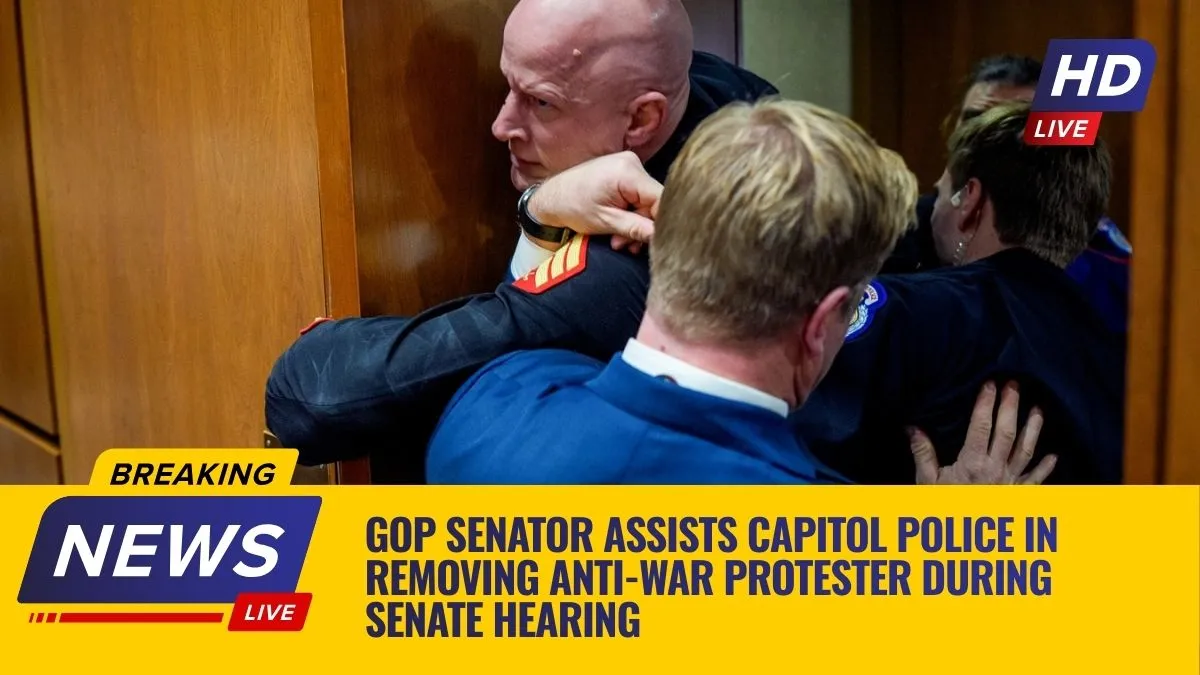
A dramatic moment unfolded in Washington, D.C., when Republican Senator Tim Sheehy helped U.S. Capitol Police detain an anti-war protester during a Senate Armed Services subcommittee hearing on Wednesday. The protest was related to the war in Iran, and the confrontation occurred inside the Hart Senate Office Building shortly before 3 p.m.
The protester was later identified by authorities as Brian McGinnis, a 44-year-old Marine veteran from North Carolina who is currently running for the U.S. Senate as a Green Party candidate.
The incident quickly gained attention after a video of the altercation circulated online, showing officers and the senator attempting to remove McGinnis from the hearing room.
What Happened Inside the Hearing Room
According to reports, the disruption occurred during a Senate Armed Services subcommittee hearing when McGinnis began protesting U.S. policies regarding the conflict involving Iran.
As officers attempted to escort him out of the room, Senator Tim Sheehy (R-Mont.) stepped in to assist the Capitol Police.
Sheehy later addressed the incident on social media platform X, explaining that officers were trying to remove a protester who was resisting their efforts.
He wrote that the protester was “fighting back,” and that he intervened to help calm and control the situation.
A video posted online showed several police officers and the senator trying to pull McGinnis away from the doorway after he reportedly wrapped his arms around the door frame to resist removal.
Doorway Struggle Leads to Injury Concerns
During the confrontation, McGinnis’s hand became stuck in the doorway, creating a tense situation as officers attempted to pull him out of the hearing room.
Witnesses in the room could be heard shouting warnings, saying “his hand, his hand!” while officers tried to free him.
Eventually, officers stopped pulling and lowered the protester back down after realizing his arm was trapped. After that moment, Senator Sheehy walked away and returned toward the front of the room.
Someone nearby asked McGinnis whether his hand was injured. He responded that his hand was not okay, suggesting he may have been hurt during the struggle.
Charges Filed Against the Protester
Following the incident, U.S. Capitol Police confirmed that McGinnis had been arrested and was facing several charges.
Charges Against Brian McGinnis
| Charge | Description |
|---|---|
| Assault on a Police Officer | Three counts filed by authorities |
| Resisting Arrest | Three counts related to resisting officers |
| Unlawful Demonstration | Charged with crowding, obstructing, and incommoding |
Police reported that three officers were treated for injuries after the encounter.
Officials also stated that McGinnis was treated after he injured himself while resisting removal, particularly when his arm became trapped in the doorway.
Capitol Police Statement on the Incident
The Capitol Police described the protester as an “unruly individual” who disrupted the hearing and created a dangerous situation.
According to their statement, McGinnis attempted to force his way back into the hearing room while resisting officers who were trying to escort him out.
Authorities emphasized that demonstrations are not permitted inside Congressional buildings, although there are designated areas outside where protests are allowed.
The agency also noted that by resisting removal, the protester placed both officers and others present at risk.
Protester’s Message Before the Arrest
Earlier the same day, McGinnis had posted a video on X explaining his purpose for being in Washington.
In the video, he said he was in Washington, D.C., to protest Senate actions related to potential military conflict involving Iran.
He questioned why American troops might be sent into harm’s way, stating that elected officials had previously suggested there would be no large-scale war.
McGinnis also addressed people who feel disappointed or betrayed by government decisions, encouraging them to join him in demanding accountability.
Political Background of Brian McGinnis
McGinnis is not only a protester but also a political candidate.
According to his campaign website:
- He is running for the U.S. Senate in North Carolina.
- His candidacy is under the Green Party.
- He previously served as a U.S. Marine.
His campaign reportedly focuses on government accountability and anti-war policies.
Role of Senator Tim Sheehy
Senator Tim Sheehy, a Republican representing Montana, drew attention for personally assisting law enforcement officers during the incident.
While it is unusual for a senator to physically participate in removing a protester, Sheehy said he stepped in because the situation appeared to be escalating.
According to his statement, his goal was to help de-escalate the confrontation and support officers trying to restore order inside the hearing.
When asked for further comment, Sheehy’s office referred reporters to the senator’s post on social media.
Rules About Protests in Congressional Buildings
Security officials emphasized that protests are prohibited inside Congressional offices and hearing rooms.
Where Protests Are Allowed
| Location | Allowed |
|---|---|
| Inside Congressional buildings | Not allowed |
| Capitol grounds outside | Allowed |
| Designated demonstration areas | Allowed |
Authorities encourage demonstrators to express their views outside the buildings on Capitol grounds, where public protests are permitted under established rules.
The confrontation involving Senator Tim Sheehy, Capitol Police, and anti-war protester Brian McGinnis highlights the tension that can arise when political demonstrations occur inside government buildings.
While McGinnis aimed to draw attention to concerns about potential war involving Iran, authorities say his actions violated rules that prohibit protests inside congressional spaces.
The incident resulted in multiple charges against the protester and injuries to several officers. It also sparked debate online about the role of elected officials during security incidents and the limits of protest inside government institutions. As McGinnis continues his campaign for the U.S. Senate, the event has added a new layer of controversy to his political profile.