
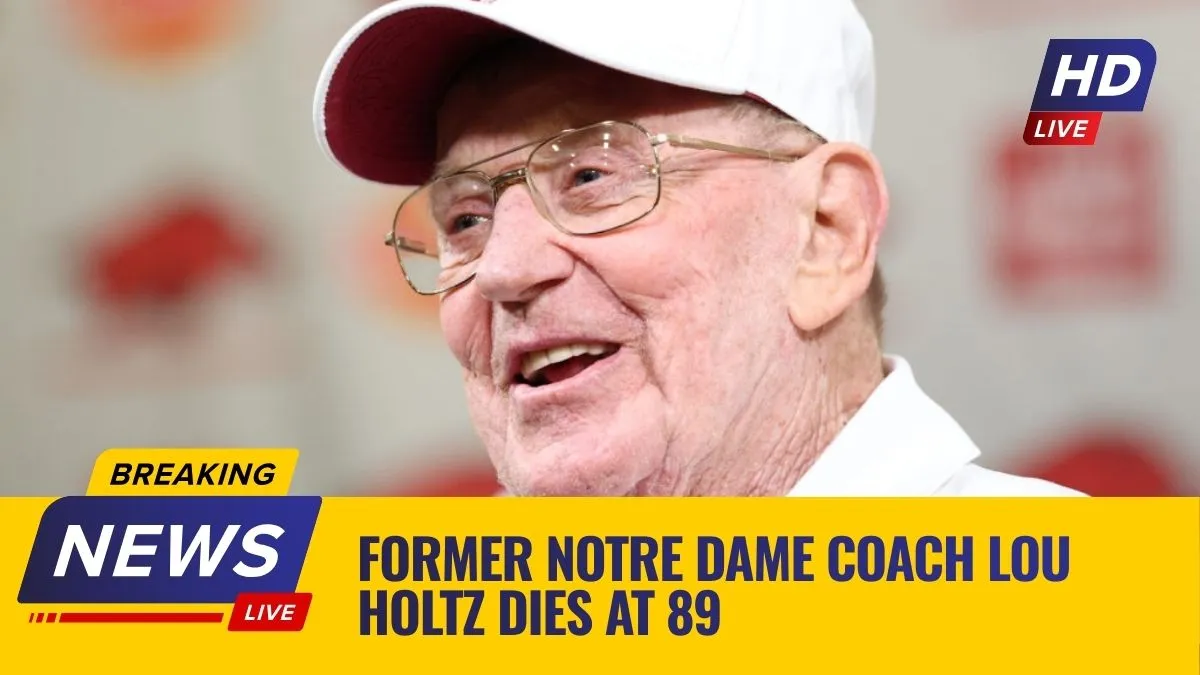
The world of college football is mourning the loss of legendary coach Lou Holtz, who passed away on March 4 at the age of 89. Known for leading Notre Dame to the 1988 national championship, Holtz spent decades shaping college football and mentoring players across multiple universities.
His career stretched across nearly five decades, leaving a lasting legacy as one of the most influential figures in college football history.
A Long and Influential Coaching Career
Early Coaching Journey
Lou Holtz built a reputation as a disciplined and motivational leader during his long coaching career. Over the course of his tenure as a head coach, he led six different college programs to bowl games, setting an NCAA record.
He also guided four different schools to Top 25 rankings, demonstrating his ability to rebuild struggling programs and turn them into competitive teams.
Although Holtz briefly coached in the National Football League (NFL) with the New York Jets in 1976, his professional stint lasted less than one season. His greatest success came at the college level, where his leadership style and motivational approach became widely respected.
Building Notre Dame Back to Glory
Arrival at Notre Dame
When Notre Dame hired Lou Holtz in 1986, the famous Fighting Irish football program had experienced several years of mediocre results. Holtz quickly changed the culture of the team and began building a championship contender.
Within just three seasons, his vision transformed Notre Dame into a dominant force in college football.
The Historic 1988 National Championship
The defining moment of Holtz’s career came in 1988, when the Notre Dame Fighting Irish completed a perfect 12–0 season.
The team featured standout players such as:
- Quarterback Tony Rice
- Running backs Mark Green and Ricky Watters
- Receiver and kick returner Raghib Ismail
During the season, Notre Dame defeated four ranked opponents, proving themselves as one of the best teams in the country.
Their championship run concluded with a 34–21 victory over the West Virginia Mountaineers in the Fiesta Bowl, which secured No. 1 rankings in both the AP Poll and Coaches Poll.
Holtz once reflected on the doubts surrounding Notre Dame at the time, saying many believed the program could not succeed because of its strict academic standards, difficult schedule, lack of redshirting, and absence of an athletic dormitory.
Consistent Success at Notre Dame
After the national championship season, Holtz continued to lead Notre Dame football to strong results.
The Fighting Irish finished with one-loss seasons in 1989 and 1993, placing second in national polls both years.
Holtz eventually stepped down in 1996, finishing his Notre Dame tenure with an impressive 100–30–2 record. His success during this period firmly established him among the greatest college football coaches of all time.
Broadcast Career and Return to Coaching
Following his departure from Notre Dame, Holtz transitioned into television, working as a college football analyst for CBS Sports.
However, his time away from coaching did not last long. Holtz returned to the sidelines when he accepted the head coaching position at South Carolina.
South Carolina Success
Holtz quickly turned the South Carolina Gamecocks into a competitive program. In 2000, he was named SEC Coach of the Year, recognizing his efforts in revitalizing the team.
Under his leadership, South Carolina reached consecutive bowl games for the first time in school history.
Controversy and Final Coaching Years
Holtz’s final years at South Carolina were not without challenges.
In November 2004, a highly publicized 10-minute brawl between South Carolina and Clemson players occurred following a rivalry game. The incident resulted in both schools declining bowl invitations that season.
After Holtz left the program, South Carolina was placed on NCAA probation, marking the third program he coached that faced NCAA sanctions.
Despite these controversies, Holtz remained a respected figure in the sport.
Television Career and Public Life
After retiring from coaching, Holtz returned to broadcasting as a college football analyst for ESPN, where he worked for a decade.
His outspoken personality made him a recognizable television figure. Outside football, Holtz was also known for his political views and conservative activism.
During the early 1980s, while coaching at Arkansas, he supported Republican Senator Jesse Helms, who was controversial due to his opposition to civil rights legislation.
Holtz also considered entering politics himself. In 2009, he explored the possibility of running for Congress in Florida, but ultimately chose not to pursue the campaign.
Legacy of Lou Holtz in College Football
Few coaches had the lasting impact that Lou Holtz achieved in college football.
His coaching philosophy focused on discipline, preparation, and personal development, helping shape the careers of countless student-athletes. Many former players credited Holtz not only for their success on the field but also for the life lessons he taught.
Holtz’s ability to transform struggling programs into competitive teams cemented his place in the College Football Hall of Fame.
The death of Lou Holtz at age 89 marks the end of a remarkable chapter in college football history. From rebuilding Notre Dame’s football program to mentoring players across several universities, Holtz left an enduring legacy that extended far beyond wins and championships.
His 1988 national championship season, leadership style, and decades of influence continue to shape the sport today. For many fans and players, Holtz will always be remembered as a teacher, mentor, and one of the greatest coaches in college football history.