
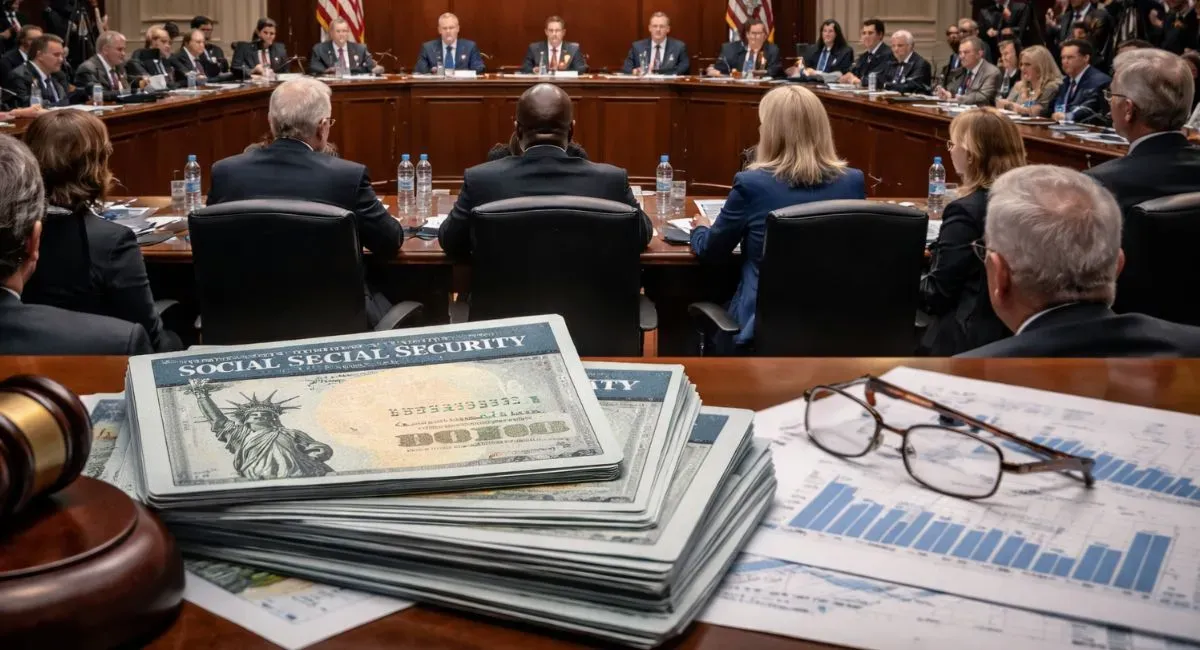
The Social Security Future took center stage as the Senate Budget Committee convened a hearing in Washington, D.C., on March 25, 2026.
During the session, officials and lawmakers addressed growing concerns about the program’s long-term sustainability and the urgent need for reform.
Key Warning on Trust Fund Depletion
Karen Glenn, Chief Actuary of the Social Security Administration, cautioned lawmakers that the combined trust funds supporting the program are expected to run out by 2034. If no corrective action is taken, beneficiaries could face an estimated 20% reduction in payments.
She emphasized that safeguarding the Social Security Future will require Congress to act soon. According to Glenn, potential solutions include:
- Increasing program revenue by about one-third
- Reducing scheduled benefits by roughly one-fourth
- Implementing a balanced mix of both strategies
Without intervention, the Social Security Future remains at significant risk.
Republican Proposal: Investment-Based Approach
Republican Senator Bill Cassidy of Louisiana proposed an alternative strategy to strengthen the Social Security Future by creating a diversified investment fund. He referenced a similar approach used in 2001 for the Federal Railroad Retirement System.
Cassidy explained that allowing trust funds to be invested in broader financial instruments helped that system recover and remain financially stable. He believes adopting a comparable model could improve the Social Security Future by generating higher returns over time.
Democratic Perspective: Increasing Revenue
On the other hand, Democrats focused on boosting revenue to protect the Social Security Future. Senator Jeff Merkley of Oregon highlighted concerns about the current payroll tax cap.
He pointed out that both average workers and wealthy individuals are subject to the same earnings cap—currently $184,500—for Social Security taxes. While most workers pay taxes on all their income, high earners contribute only up to the cap, resulting in a disproportionate burden.
Democrats argue that closing such tax gaps could significantly strengthen the Social Security Future without cutting benefits.
Need for Bipartisan Action
The hearing underscored a clear divide in approaches but also highlighted a shared understanding: action is necessary. Both parties agree that preserving the Social Security Future requires timely and effective policy decisions.
The discussion around the Social Security Future reflects the urgency of addressing financial challenges facing one of America’s most vital programs.
With trust funds projected to deplete by 2034, policymakers must find common ground between revenue increases, benefit adjustments, and investment strategies.
The path forward will require bipartisan cooperation to ensure that future generations continue to rely on a stable and secure Social Security system.
FAQs
1. What is the main concern about the Social Security Future?
The biggest concern is that trust funds may be depleted by 2034, leading to a potential 20% cut in benefits.
What solutions are being proposed to secure the Social Security Future?
Proposals include increasing revenue, reducing benefits, or creating investment funds to grow assets.
Why is the payroll tax cap being debated?
Lawmakers argue it unfairly limits contributions from high-income earners, impacting the long-term Social Security Future.