
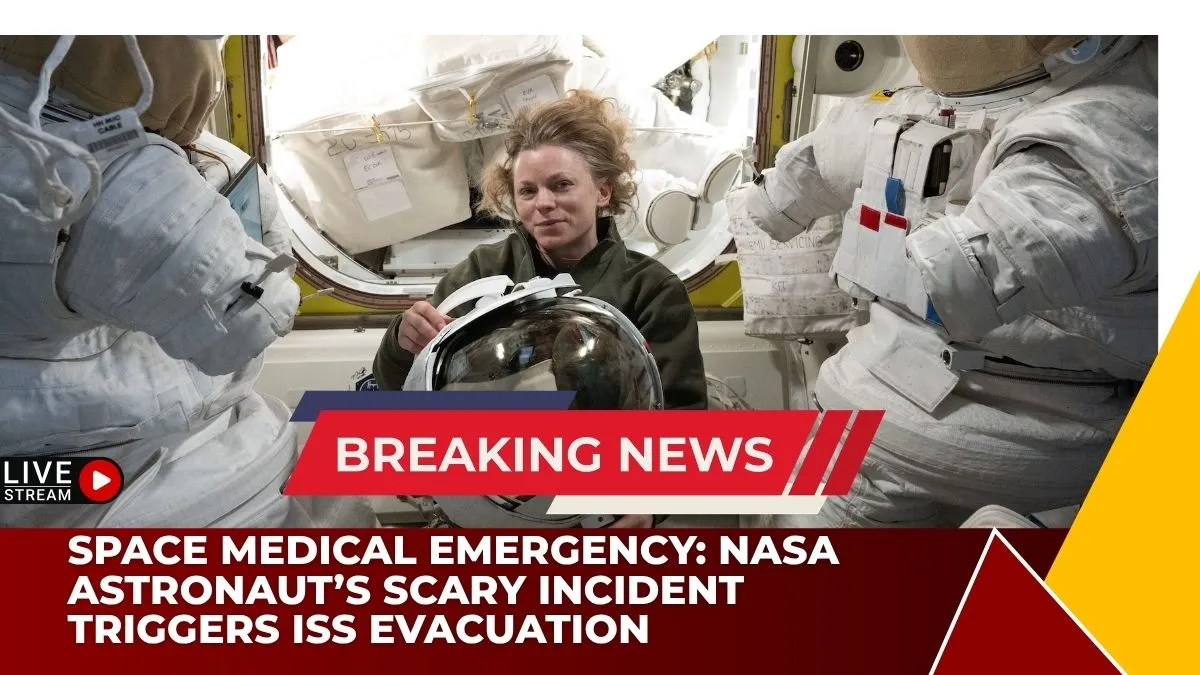
A shocking Space Medical Emergency unfolded aboard the NASA International Space Station (ISS) when astronaut Mike Fincke suddenly lost his ability to speak.
This unexpected Space Medical Emergency led to the first-ever evacuation in the 25-year history of continuous human presence on the orbiting laboratory.
The incident raised serious concerns about astronaut health and highlighted the unpredictable risks associated with long-duration space missions.
What Happened During the Incident?
The Space Medical Emergency occurred earlier this year while Fincke was having dinner with fellow crew members aboard the International Space Station. Without warning, he became unable to speak for approximately 20 minutes.
According to Fincke, the episode came “completely out of the blue” and escalated within seconds. The crew had just completed preparations for a planned spacewalk, which had to be immediately cancelled due to the unfolding Space Medical Emergency.
Recognizing the seriousness of the situation, the crew quickly contacted flight surgeons at mission control in Houston. The response was immediate, with all available personnel mobilized to address the Space Medical Emergency.
Emergency Response and Evacuation
As the situation developed, NASA made the unprecedented decision to evacuate the crew. Within days, four astronauts boarded a SpaceX Crew Dragon spacecraft to return to Earth.
The capsule safely splashed down in the Pacific Ocean on January 15. From there, the crew was transported via helicopter to Scripps Memorial Hospital La Jolla for immediate medical evaluation.
This marked the first time a Space Medical Emergency required a full evacuation from the ISS, setting a significant precedent in space mission protocols.
Medical Mystery: What Caused It?
Despite extensive testing, doctors have not been able to determine the exact cause of this Space Medical Emergency. Medical professionals have ruled out common issues such as choking or a heart attack.
One possible explanation being considered is the effect of prolonged exposure to microgravity. Fincke had spent about five and a half months aboard the ISS at the time of the incident.
Scientists have long studied how space affects the human body, including:
- Bone density loss
- Vision impairment
- Muscle atrophy
However, a temporary loss of speech as seen in this Space Medical Emergency remains unexplained and adds a new dimension to ongoing research.
Astronaut’s Perspective and Recovery
Fincke, a 59-year-old retired U.S. Air Force colonel, described the experience as both sudden and alarming. Despite his long history of good health, the Space Medical Emergency came as a complete surprise to him and his team.
Following his return to Earth, he underwent numerous medical tests, yet no definitive diagnosis has been made. Fortunately, he has since recovered and continues to maintain good health.
Remarkably, despite experiencing such a serious Space Medical Emergency, Fincke has expressed his desire to return to space in the future.
Impact on Future Space Missions
This Space Medical Emergency has significant implications for future missions, especially those involving long-duration stays or deep-space travel to destinations like Mars.
NASA and other space agencies may need to:
- Improve onboard medical monitoring systems
- Develop faster emergency evacuation protocols
- Expand research into neurological effects of space
The incident underscores the importance of preparedness and adaptability in human spaceflight.
The Space Medical Emergency involving Mike Fincke serves as a stark reminder of the unknown challenges astronauts face beyond Earth. While space exploration continues to push boundaries, incidents like this highlight the need for advanced medical research and emergency response strategies.
Even with decades of experience, space remains unpredictable. This event not only marks a historic first for the ISS but also opens new avenues for understanding human health in space. As agencies like NASA continue their missions, ensuring astronaut safety will remain a top priority.