
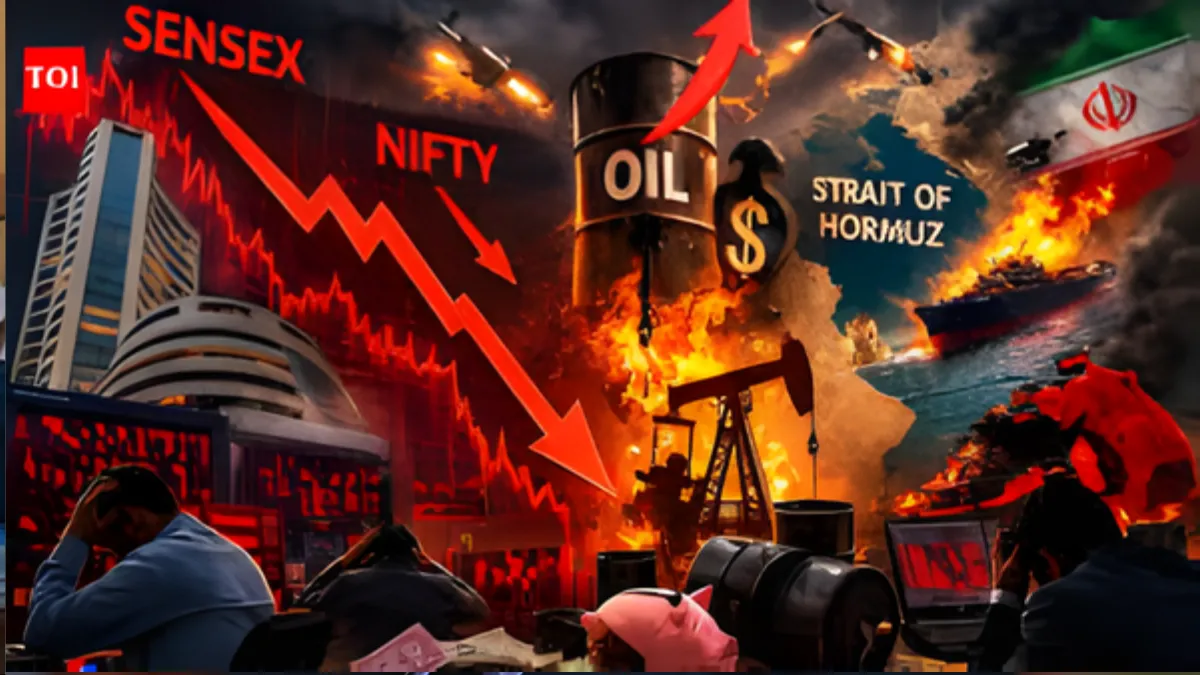
The Iran War Market Crash has triggered widespread volatility across global financial markets, with stocks, bonds, and gold declining sharply while oil prices surged.
Investors are increasingly concerned about prolonged geopolitical tensions, rising inflation, and uncertain central bank policies, all of which are shaping the current market landscape.
Sharp Decline in Stock Markets
The Iran War Market Crash significantly impacted US equities on Friday. Major indices recorded notable losses:
- The Dow Jones Industrial Average dropped 444 points (0.96%)
- The S&P 500 fell 1.51%
- The Nasdaq Composite declined 2.01%
The Russell 2000, which reflects smaller companies sensitive to interest rate changes, dropped 2.26%, entering correction territory—defined as a fall of 10% or more from recent highs. It is now down 10.3% from its January peak.
Additionally:
- The Nasdaq is down 9.65% from its October peak, nearing correction levels
- The Dow has declined about 9.2% from its February high
- The S&P 500 has fallen 6.77% from its January peak
Both the S&P 500 and Nasdaq closed at their lowest levels since September, wiping out six months of gains, while the Dow reached its lowest point since October.
Bond Market Sell-Off Intensifies
The Iran War Market Crash also extended to the bond market, where investors began selling off government securities.
- The US 10-year Treasury yield rose to 4.39%, its highest level since July
- Rising yields reflect expectations of higher inflation and prolonged interest rates
Globally:
- The UK 10-year bond yield surged past 4.9%, reaching its highest level since 2008
- The FTSE 100 index in London dropped 1.44%
Higher yields tend to draw investors away from equities, further intensifying the sell-off in stocks.
Gold Sees Historic Weekly Loss
Traditionally considered a safe-haven asset, gold failed to provide stability during the Iran War Market Crash.
- Gold prices fell 2% on Friday
- Weekly losses exceeded 10%, marking the worst performance since 1983
This unexpected decline suggests investors are prioritizing liquidity and adjusting portfolios amid extreme uncertainty.
Oil Prices Surge Amid Conflict
While most asset classes declined, oil prices rose sharply due to supply concerns linked to the conflict.
- Brent crude increased 3.26%, settling at $112.19 per barrel
- This marks its highest closing price since July 2022
- US crude oil rose 2.27% to $98.32 per barrel
The surge in energy prices is fueling inflation fears and complicating monetary policy decisions worldwide.
Investor Sentiment and Market Outlook
The ongoing Iran War Market Crash has deeply affected investor sentiment. Initially, markets assumed the conflict would be short-lived. However, escalating tensions and uncertainty about its duration have changed expectations.
Key concerns include:
- Persistent inflation due to rising oil prices
- Higher-for-longer interest rates
- Global economic slowdown risks
Market volatility also increased significantly:
- The VIX (fear index) surged 11%, indicating heightened investor anxiety
Additionally, reports suggesting potential deployment of US troops to Iran further rattled markets, contributing to late-session declines.
Extended Market Weakness
The Iran War Market Crash has led to sustained losses over several weeks:
- The Dow Jones has declined for four consecutive weeks, its longest losing streak in three years
- The S&P 500 has also dropped for four straight weeks, marking its longest losing streak in a year
Analysts believe the market has not yet reached a bottom, as investors continue to evaluate the long-term impact of the conflict and rising oil prices.
The Iran War Market Crash highlights how geopolitical conflicts can disrupt global financial stability. With stocks and bonds falling simultaneously and gold failing to act as a safe haven, investors are facing a highly uncertain environment.
Rising oil prices are adding inflationary pressure, complicating decisions for central banks and prolonging market volatility.
Until there is clarity on the duration and outcome of the conflict, markets are likely to remain unstable, with further downside risks possible.