
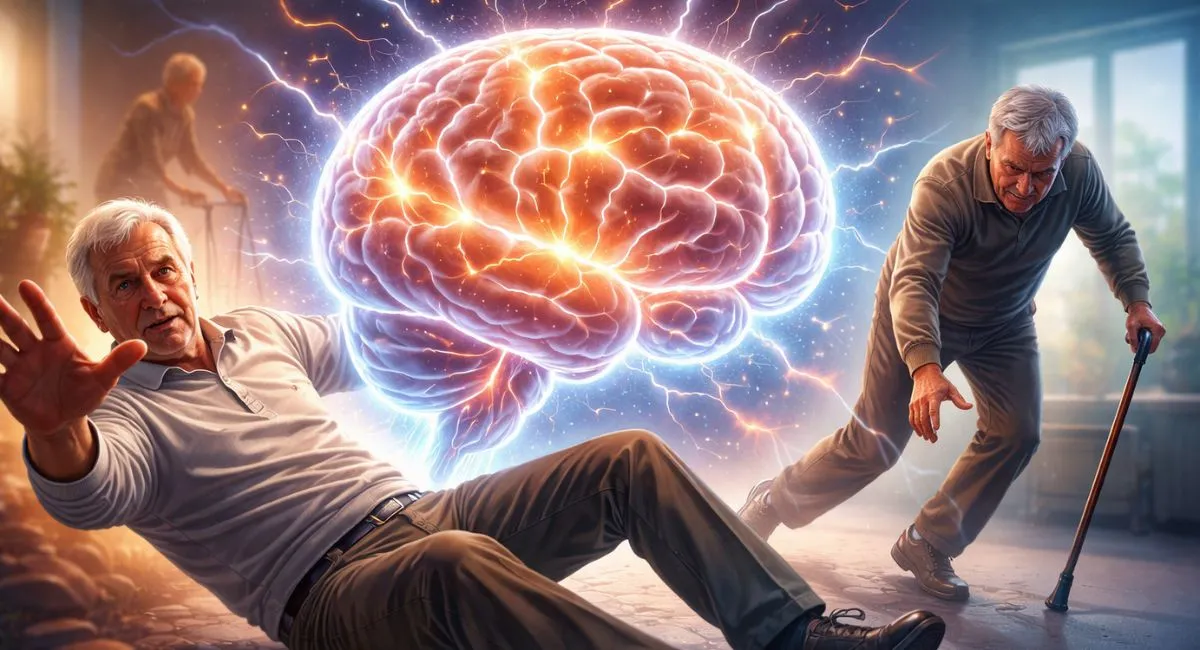
The concept of Brain Overdrive is gaining attention as researchers uncover how it impacts balance and fall risk.
New findings reveal that both aging individuals and people with Parkinson’s disease experience Brain Overdrive, where the brain works excessively hard to maintain stability.
While this might seem beneficial, it actually reduces the body’s ability to recover from sudden balance disturbances, increasing the likelihood of falls.
Understanding Brain Overdrive in Balance Control
In healthy young adults, balance recovery follows a highly efficient process. When a sudden disturbance occurs—such as slipping—the body responds with a two-phase neural reaction.
The first is an automatic reflex controlled by the brainstem, followed by a second, more complex response involving higher brain centers.
However, in older adults and individuals with Parkinson’s disease, this process changes significantly.
The study shows that even minor balance disruptions trigger Brain Overdrive, meaning the brain produces exaggerated activity levels compared to younger individuals handling more intense disturbances. This suggests reduced neural efficiency.
Key Findings of the Study
1. Neural Inefficiency in Ageing
One of the most striking discoveries is that Brain Overdrive reflects inefficiency rather than strength. Older adults exhibit stronger brain responses for smaller balance challenges than younger individuals do for larger ones. This indicates that the brain is compensating for declining physical capabilities by working harder.
2. The Muscle Stiffening Effect
Another important factor is muscle behavior. When attempting to regain balance, older adults often activate opposing muscle groups simultaneously—a phenomenon known as co-contraction. While this may seem stabilizing, it actually leads to stiffness in joints.
This stiffness reduces flexibility and limits the body’s ability to make quick, adaptive movements. As a result, Brain Overdrive combined with muscle stiffening worsens overall balance performance rather than improving it.
3. Brain-Balance Tradeoff
The research highlights a direct tradeoff: the more the brain engages during balance tasks, the less effective the physical recovery becomes. In simple terms, Brain Overdrive leaves no “reserve capacity” for handling larger disturbances, making falls more likely.
4. Predictive Testing Through Muscle Activity
Scientists have also introduced a promising method for assessing fall risk. By analyzing muscle responses during a “rug-pull” test—where the ground is suddenly shifted—they can estimate how much the brain is working.
This approach allows researchers to detect Brain Overdrive indirectly through muscle activity, offering a non-invasive way to predict future balance issues and fall risk.
Scientific Insights Behind the Findings
The study, conducted by Lena Ting and her team at Emory University, explored how brain and muscle coordination changes with age and neurological conditions. Their analysis focused on long-latency responses (LLRs), which are delayed muscle reactions tied to different neural pathways.
Two main response phases were identified:
- LLR1 (~120 ms): Linked to subcortical (brainstem) activity
- LLR2 (~210 ms): Associated with cortical (higher brain) involvement
In older adults and Parkinson’s patients, the second phase (LLR2) was significantly amplified even at lower levels of disturbance. This confirms increased reliance on higher brain functions—another indicator of Brain Overdrive.
Additionally, the study found that certain muscle activations actually destabilize balance instead of correcting it. These destabilizing responses were strongly associated with poorer clinical balance outcomes.
Why “Trying Harder” Can Backfire?
It may seem logical that putting more effort into maintaining balance would help prevent falls. However, the concept of Brain Overdrive challenges this assumption.
When the brain operates at maximum capacity for minor disturbances, it lacks the flexibility and reserve needed for larger challenges. This results in slower, less effective recovery responses. Essentially, overcompensation leads to reduced performance.
Implications for Prevention and Treatment
Understanding Brain Overdrive opens new possibilities for fall prevention strategies. Instead of focusing solely on strength or rigidity, interventions may need to emphasize:
- Improving neural efficiency
- Encouraging fluid and coordinated movements
- Reducing unnecessary muscle co-contraction
Balance training programs could be tailored to help individuals use their brain and muscles more effectively, rather than simply increasing effort.
The discovery of Brain Overdrive provides a new perspective on why falls are more common in older adults and individuals with Parkinson’s disease.
Rather than indicating strength, increased brain activity signals inefficiency and reduced recovery capability. Combined with muscle stiffness, this overactivation creates a cycle that worsens balance.
By identifying and measuring Brain Overdrive, researchers and clinicians may be able to predict fall risk earlier and design more effective interventions.
Ultimately, improving how the brain and body work together—not just how hard they work—may be the key to preventing dangerous falls.
FAQs
1. What is Brain Overdrive?
Brain Overdrive refers to excessive brain activity during balance tasks, indicating reduced efficiency and higher fall risk.
Does muscle stiffness help prevent falls?
No, stiffness caused by activating opposing muscles actually worsens balance and limits recovery ability.
3. Can fall risk be predicted early?
Yes, tests like the rug-pull method can detect Brain Overdrive through muscle activity, helping identify at-risk individuals.