
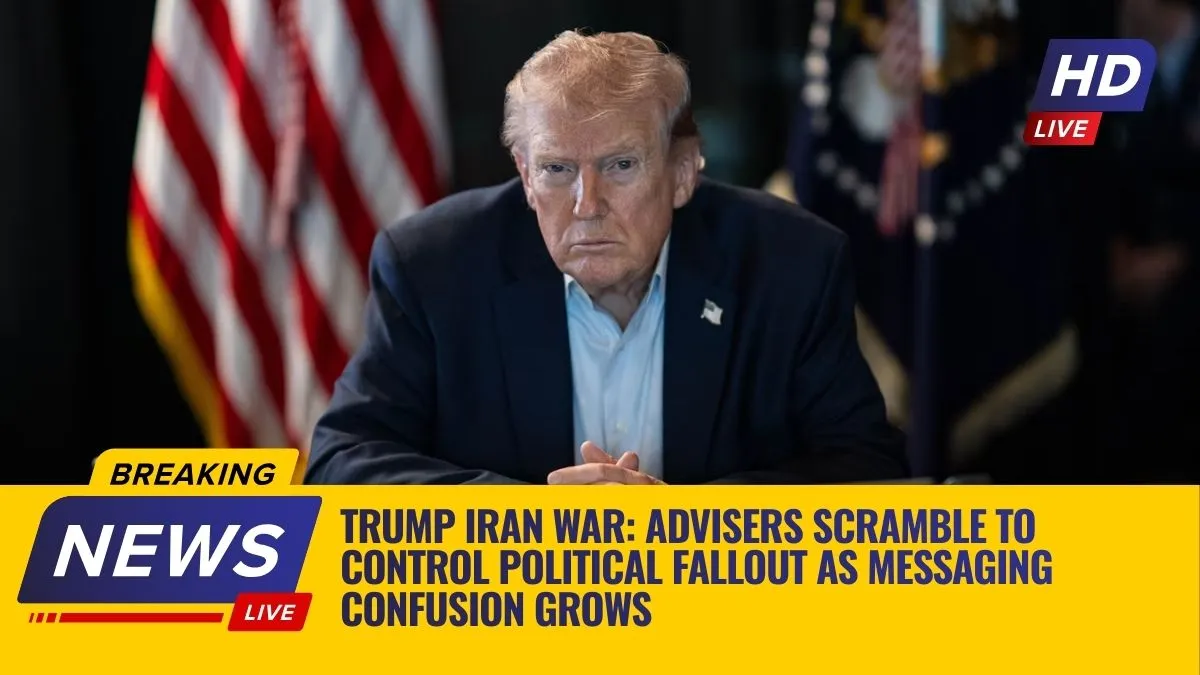
The Trump Iran War has rapidly become one of the most controversial geopolitical developments of the year, sparking deep concerns within political circles and inside the White House itself. While President Donald Trump has publicly stated that the United States is prepared to fight Iran “forever,” several advisers and allies are quietly worried about the long-term political and economic consequences of the Trump Iran War.
Only a few days into the conflict, discussions within the administration are already shifting toward how and when the United States might disengage.
According to multiple sources familiar with internal discussions, Trump’s advisers fear the Trump Iran War could become a prolonged military entanglement with unpredictable consequences for both national security and domestic politics.
Rising Political Risks Surrounding the Trump Iran War
The Trump Iran War has already led to serious concerns within the president’s inner circle. Officials say the conflict has claimed the lives of six American service members, and government agencies are preparing for the possibility that casualties could increase.
Beyond the battlefield, the Trump Iran War is also creating economic and political challenges:
- Stock markets have shown volatility
- Gasoline prices are climbing
- Public support for the war appears weak in early polling
These factors threaten to undermine key arguments the administration planned to make ahead of upcoming midterm elections. One adviser reportedly described the situation bluntly, saying the Trump Iran War carries undeniable political risk.
Trump, however, has defended the military action strongly. He has described the early strikes as a major success and emphasized the destruction of Iranian nuclear-related targets.
A major turning point in the Trump Iran War was the reported killing of Iran’s Supreme Leader, Ayatollah Ali Khamenei, which Trump views as a decisive blow against Iran’s leadership and nuclear ambitions.
Public Opinion and Divisions Within the MAGA Movement
Despite the administration’s optimistic portrayal, the Trump Iran War appears unpopular among many voters. Early polls suggest Americans remain cautious about becoming involved in another prolonged conflict in the Middle East.
Political strategists warn that the Trump Iran War could divide Trump’s own political base. The MAGA movement was originally energized by Trump’s promise during the 2016 election to avoid nation-building and regime change operations abroad.
Now, some conservative figures worry that the conflict contradicts those earlier commitments.
Republican strategist Matthew Bartlett, a former State Department official, summarized the situation clearly. According to him, the Trump Iran War could either distract from economic issues or potentially create a long-lasting political crisis for the Republican Party.
Meanwhile, the White House has publicly insisted that the decision to launch the Trump Iran War was based purely on national security concerns rather than political calculations.
White House press secretary Karoline Leavitt stated that protecting American citizens and national interests outweighed all other considerations.
Conflicting Messaging Creates Communication Chaos
Another major challenge of the Trump Iran War has been the administration’s inconsistent public messaging.
Even senior officials have offered different explanations about why the United States entered the conflict and what the ultimate objectives are.
Several key questions remain unclear:
| Issue | Conflicting Statements |
|---|---|
| Threat Level | Some officials said Iran posed an immediate threat; others described a longer-term risk |
| Nuclear Capability | Debate over whether Iran was close to nuclear weapons or developing missile technology |
| Decision to Strike | Uncertainty over whether the U.S. or Israel initiated the attack |
For example, Secretary of State Marco Rubio initially suggested the United States joined military operations after Israel decided to strike Iran. However, Trump later contradicted that claim by saying he may have pressured Israel to act sooner.
Rubio later adjusted his remarks and aligned his explanation with the president’s position.
Further confusion arose when Leavitt said Trump acted based on a “feeling” grounded in intelligence that Iran was preparing attacks against the United States.
Lack of Clear Endgame in the Trump Iran War
Perhaps the most significant concern surrounding the Trump Iran War is the absence of a clearly defined exit strategy.
Initially, the administration hinted that the goal might include regime change in Iran. However, officials have since lowered expectations, shifting the focus toward weakening Iran’s military capabilities rather than completely transforming its government.
Some Republican strategists now hope the administration can declare victory within a few weeks if Iran’s leadership and military capabilities are significantly weakened.
Still, lawmakers and political allies say the White House has offered limited clarity about:
- How long the Trump Iran War will continue
- Whether U.S. ground troops could eventually be deployed
- What conditions would mark the end of the conflict
Trump himself has given mixed signals, suggesting at different times that the war could last four to five weeks, that it was already ahead of schedule, or that the military was prepared to continue fighting indefinitely.
Immediate Challenges: Oil Markets and Americans Abroad
While political strategy debates continue, officials are dealing with the immediate consequences of the Trump Iran War.
One of the biggest concerns has been the impact on global energy markets. Because the conflict threatens major oil supply routes in the Middle East, markets have reacted nervously.
Additionally, thousands of American citizens stranded across the region require assistance and evacuation support. Officials admitted that there had been no clear plan prepared to locate or contact these individuals before the military operation began.
Trump acknowledged the rapid pace of events, stating simply that “it happened all very quickly.”
Possible Best-Case Scenario for the Trump Iran War
Despite the uncertainty, some advisers remain cautiously optimistic.
Their preferred scenario would allow the United States to complete its core military objectives quickly, significantly weaken Iran’s offensive capabilities, and withdraw from the conflict within weeks.
If that occurs, Trump could claim victory and shift attention back to domestic priorities such as the economy, energy prices, and inflation before midterm elections.
Within the administration, this optimistic outcome has been compared to what some advisers call a “Venezuela-style” strategy, referencing an earlier operation aimed at reshaping leadership in the South American country.
However, many analysts caution that Iran’s political system and regional influence make the Trump Iran War far more complex than previous foreign interventions.
The Trump Iran War has quickly evolved into a major political and strategic challenge for the White House. While President Trump portrays the conflict as a demonstration of American strength and military success, many advisers worry about the long-term political consequences.
With rising casualties, uncertain public support, economic ripple effects, and unclear war objectives, the Trump Iran War presents a delicate balancing act for the administration.
In the coming months, the key question will not only be whether the military campaign succeeds but also how the war affects voters’ perceptions of leadership, stability, and economic priorities.
Ultimately, the political impact of the Trump Iran War may depend less on early battlefield victories and more on whether Americans feel their daily lives are improving.