
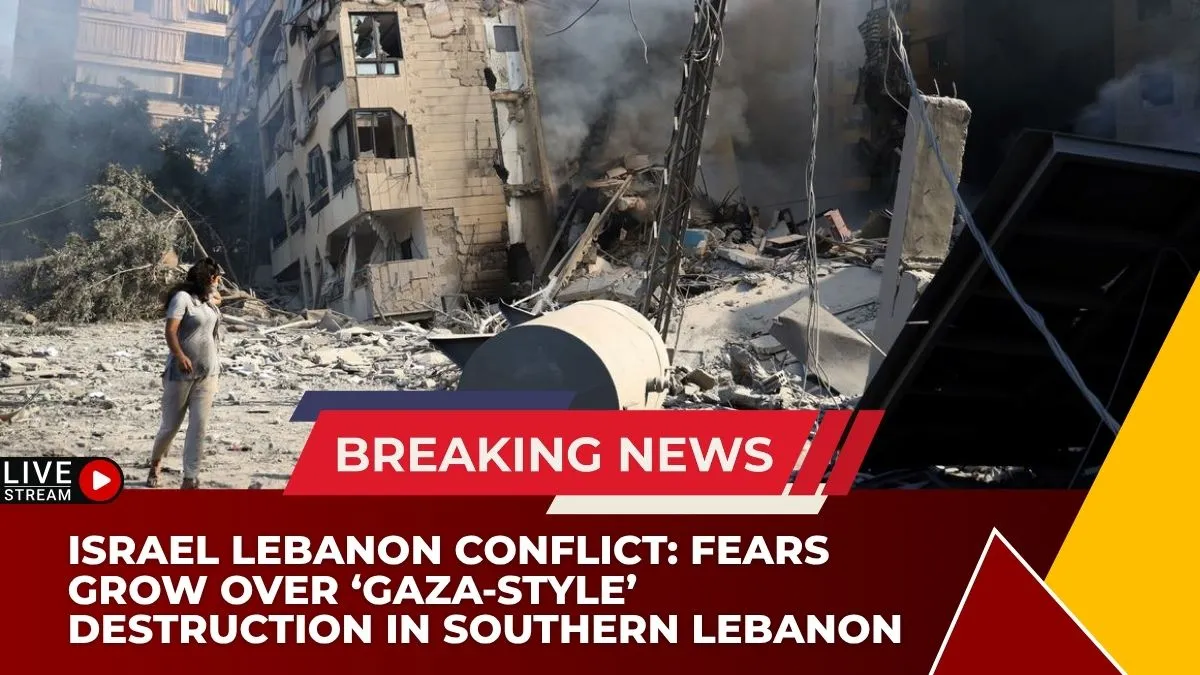
The Israel Lebanon conflict is escalating rapidly, with growing concerns that tactics used in Gaza could be repeated in southern Lebanon.
Satellite imagery and on-ground reports reveal widespread destruction, large-scale displacement, and expanding Israeli military presence, raising alarm among humanitarian groups and global leaders.
Rising Military Activity and Strategic Expansion
Recent developments show that Israel Defense Forces has reinforced multiple bases across southern Lebanon. Additional troops have joined the ground invasion, aiming to expand a proposed “security zone.”
Israeli Defense Minister Israel Katz confirmed plans to control key crossings, especially around the Litani River. This move is intended to prevent attacks from Hezbollah, which has been launching rockets into northern Israel.
Satellite images indicate that at least five previously established Israeli bases have been reinforced. Tanks and military equipment have been spotted, suggesting preparations for prolonged operations in the region.
Destruction of Infrastructure and Civilian Impact
The Israel Lebanon conflict has led to severe infrastructure damage. At least seven bridges over the Litani River have reportedly been destroyed, cutting off critical connections between southern and central Lebanon.
Residential areas have also suffered heavy damage. Entire neighborhoods have been reduced to rubble, with humanitarian organizations warning of a rapidly worsening crisis. Over 1 million people have been displaced, and more than 1,000 fatalities have been reported by Lebanese authorities.
Aid workers describe the situation as chaotic and unpredictable, with strikes occurring beyond previously identified high-risk zones. Many civilians now feel there is “no safe place,” echoing sentiments heard during the Gaza conflict.
Comparisons to the Gaza Model
The Israel Lebanon conflict is drawing comparisons to Israel’s military campaign in Gaza Strip, which followed the October 7 attacks. That offensive resulted in widespread devastation and tens of thousands of deaths.
Katz openly referenced operations in areas like Rafah, which were heavily damaged during the Gaza campaign. He warned that displaced Lebanese civilians may not be allowed to return until security conditions improve.
Currently, Israeli forces still control parts of Gaza, maintaining buffer zones that cover a significant portion of the territory. Similar strategies appear to be emerging in Lebanon.
International Concerns and Legal Questions
Global leaders are increasingly worried about the humanitarian consequences of the Israel Lebanon conflict. António Guterres has urged both sides to halt hostilities, warning that the “Gaza model must not be replicated in Lebanon.”
Human rights experts argue that the destruction of civilian homes may violate international humanitarian law unless those structures are used for military purposes. Human Rights Watch has also accused Israel of using white phosphorus in populated areas—claims that Israel denies.
Meanwhile, Israel maintains that its operations target Hezbollah infrastructure and are necessary for national security.
Regional Tensions and Broader Conflict
The Israel Lebanon conflict is part of a wider regional escalation involving Iran. Hezbollah’s actions are seen as retaliation for Israeli strikes linked to Iran.
The conflict intensified after a joint U.S.-Israeli operation reportedly killed Iran’s Supreme Leader Ali Khamenei, triggering broader instability.
Some Israeli officials, including Finance Minister Bezalel Smotrich, have even suggested permanent control over territories south of the Litani River for strategic reasons.
Humanitarian Crisis Deepens
The humanitarian situation continues to deteriorate. Families are being displaced multiple times due to evacuation orders and ongoing airstrikes. Access to food, shelter, and medical care is becoming increasingly limited.
Local voices express fear and frustration—not only toward Israel but also toward Hezbollah for escalating the conflict. Many citizens worry about a long-term occupation and the loss of stability in Lebanon.
The Israel Lebanon conflict is rapidly evolving into a major humanitarian and geopolitical crisis. With increasing military operations, widespread destruction, and rising displacement, fears of a prolonged conflict are intensifying.
Comparisons to Gaza highlight the potential for long-term devastation if tensions are not de-escalated.
Immediate international intervention and diplomatic efforts are crucial to prevent further suffering and restore stability in the region.