
The possible discovery of a Mars New Mineral has sparked major interest among planetary scientists studying the Red Planet.
Orbital spectral signals that puzzled researchers for almost twenty years now appear to point toward a rare iron sulfate compound that may represent a previously unknown mineral form on Mars.
Researchers used a combination of spacecraft observations and laboratory simulations to interpret the unusual chemical signatures. Although the evidence is compelling, scientists emphasize that the identification of this potential Mars New Mineral is still preliminary and requires further confirmation through future missions.
Study Raises Questions About the Mars New Mineral
A recent scientific study analyzed mysterious spectral data collected from Mars orbit. The research suggests that the signals could be explained by a rare compound known as ferric hydroxysulfate. This material may represent a candidate for a Mars New Mineral, but scientists stress that the evidence is indirect.
The investigation was led by planetary scientists who combined experimental chemistry with remote observations. Their work focused on identifying the chemical reactions that could create this unusual mineral phase under Martian environmental conditions.
The researchers highlighted that the study describes the material as an uncommon ferric hydroxysulfate phase rather than definitively labeling it as a newly confirmed mineral species. This distinction is important because formal mineral recognition typically requires direct physical analysis of the material.
Orbital Evidence from Sulfate-Rich Regions
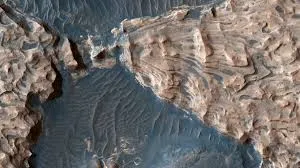
The possible Mars New Mineral was identified in layered sulfate deposits located near one of the planet’s most dramatic geological regions. These formations occur around a vast canyon system and specifically in areas known for chaotic terrain and plateau landscapes.
Orbital instruments detected unusual spectral patterns within these deposits that did not correspond to any previously cataloged minerals. Scientists believe these layered sulfates formed through a complex sequence of hydration, heating, and chemical alteration events.
The deposits appear as thin sulfate layers positioned above and below basaltic rock formations. Their geological placement suggests they were influenced by volcanic activity or thermal processes occurring after the sediments were originally deposited.
Laboratory Experiments Recreate Martian Chemistry
To better understand the potential Mars New Mineral, researchers recreated the conditions of Martian sulfate deposits in laboratory experiments. These tests demonstrated how certain iron sulfate minerals transform when exposed to heat and oxygen.
Scientists found that a hydrated iron sulfate called rozenite can change into another mineral known as szomolnokite when heated to roughly 50°C. When temperatures rise above 100°C and oxygen is present, further chemical reactions can produce ferric hydroxysulfate.
These laboratory results closely matched the infrared absorption patterns observed from orbit around Mars. The similarity between the simulated reactions and the spacecraft data strengthens the argument that this chemical transformation may explain the unknown spectral signatures linked to the possible Mars New Mineral.
Geological Clues From Layered Mineral Deposits
The structure of the sulfate deposits also provides important evidence supporting the Mars New Mineral hypothesis. Researchers examined the layering patterns within these formations to reconstruct the environmental history of the region.
The geological sequence shows polyhydrated sulfates lying above monohydrated sulfates, while ferric hydroxysulfate appears within certain layers. This pattern suggests that the deposits underwent multiple stages of hydration and dehydration over time.
These transformations likely occurred in response to environmental changes such as volcanic heat, oxygen exposure, and limited water activity. Such conditions could have altered earlier minerals and eventually produced the material now considered a candidate Mars New Mineral.
Why Scientists Remain Cautious?
Despite strong evidence, experts note that identifying a Mars New Mineral using orbital observations alone is not enough for official classification. Mineral recognition normally requires direct measurements of chemical composition and crystal structure.
At present, the available data includes spectral readings from orbit, laboratory simulations, and geological interpretation. While these methods provide strong support for the hypothesis, they do not offer the same certainty as direct analysis of a physical sample.
Future missions equipped with advanced instruments could analyze Martian rocks on the surface. Such investigations may finally determine whether this compound truly qualifies as a new mineral species.
Implications for Mars’ Environmental History
If confirmed, the Mars New Mineral could reveal important information about the planet’s past climate and geochemical processes. Sulfate deposits are widely considered evidence that water once existed on Mars in significant amounts.
The presence of ferric hydroxysulfate would suggest that these deposits experienced later heating and oxidation. This implies a complex environmental history involving water activity followed by volcanic or thermal alteration.
Understanding these processes helps scientists reconstruct how Mars evolved from a potentially wetter world into the cold, dry planet observed today.
The evidence for a Mars New Mineral provides an intriguing glimpse into the geological complexity of the Red Planet.
Spectral observations, laboratory experiments, and stratigraphic analysis together suggest that a rare ferric hydroxysulfate compound may exist within Martian sulfate deposits.
However, without direct in-situ measurements, scientists cannot yet confirm its status as a formally recognized mineral. Future missions capable of detailed mineralogical analysis will be essential to verify the discovery.
If confirmed, this finding could significantly improve our understanding of Mars’ environmental evolution and the chemical processes that shaped its surface.