
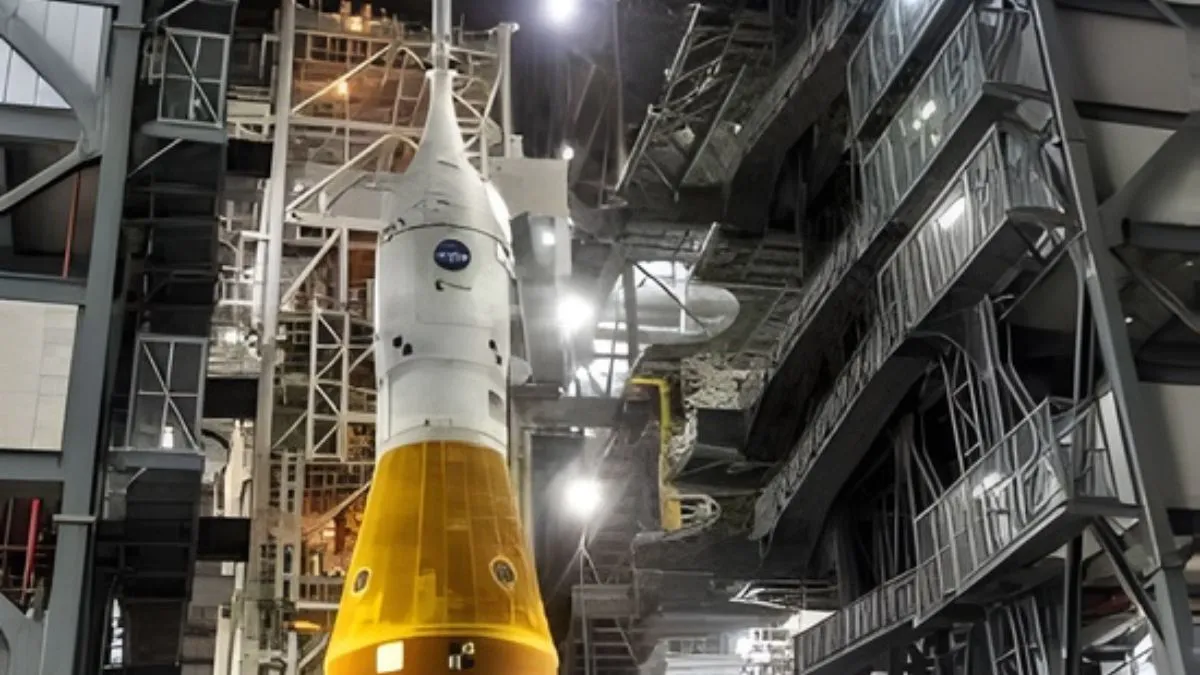
The NASA SLS rollout marks a critical milestone as NASA prepares for its upcoming Artemis 2 mission.
After undergoing repairs inside the Vehicle Assembly Building at Kennedy Space Center, the massive Space Launch System rocket is set to journey back to Launch Complex 39B, paving the way for a planned April flight.
Rocket Rollout Begins After Repairs
Following necessary fixes, the NASA SLS rollout process will begin Thursday night. The towering 322-foot Space Launch System rocket, mounted on a 400-foot Mobile Launcher, will slowly travel approximately four miles to the launch pad.
The movement will be carried out by NASA’s crawler transporter, with initial motion expected around 8:30 p.m. EDT (0030 UTC). The entire journey is anticipated to take nearly 12 hours, showcasing the scale and precision involved in this operation.
This NASA SLS rollout is a crucial step toward the Artemis 2 launch attempt, currently scheduled no earlier than April 1.
Reason Behind the Delay and Repairs
The NASA SLS rollout follows a temporary setback that forced the agency to delay its original March launch plan. Engineers identified a helium flow issue in the rocket’s upper stage after a successful fueling test conducted on February 21.
To address the problem, NASA moved the rocket and its Orion spacecraft back into the Vehicle Assembly Building. Alongside resolving the helium issue, technicians also completed additional prelaunch tasks, including:
- Replacing batteries linked to the flight termination system
- Inspecting the solid rocket boosters, core stage, and upper stage
- Conducting final system checks
These efforts ensured that the NASA SLS rollout could proceed safely and efficiently.
Artemis 2 Mission Overview
The NASA SLS rollout supports the Artemis 2 mission, which will be a historic crewed test flight. Astronauts aboard the mission include:
- Reid Wiseman
- Victor Glover
- Christina Koch
- Jeremy Hansen
This mission will send astronauts around the Moon, marking the first time humans will live and work inside the Orion spacecraft during deep space travel. The crew is expected to complete a roughly 10-day journey before splashing down in the Pacific Ocean.
The NASA SLS rollout is therefore essential in enabling this next phase of human space exploration.
Future Artemis Program Changes
Recent announcements by NASA Administrator Jared Isaacman have introduced key updates to the Artemis program. These changes impact future missions, including:
- Delaying the first Moon landing to Artemis 4
- Redefining Artemis 3 as an Earth-orbit demonstration mission
- Testing Orion docking with lunar landers such as:
- Starship
- Blue Moon Mk.2
These developments add further importance to the NASA SLS rollout, as Artemis 2 will act as a stepping stone toward these more complex missions.
International Collaboration and Expectations
The NASA SLS rollout also highlights global cooperation in space exploration. The European Space Agency is closely involved in Artemis planning.
ESA Director General Josef Aschbacher expressed optimism about upcoming discussions in Washington, D.C., where NASA will share more details about future mission architecture.
European member states have shown strong support for collaboration, ensuring a unified international approach to lunar exploration. This cooperation strengthens the significance of the NASA SLS rollout within the broader Artemis framework.
Live Coverage and Public Engagement
As the NASA SLS rollout unfolds, live coverage will begin shortly before the crawler transporter starts moving. This allows space enthusiasts worldwide to witness a key moment in real-time.
Such transparency and engagement reflect NASA’s commitment to involving the public in its journey back to the Moon.
The NASA SLS rollout represents a major step forward in the Artemis program, bringing humanity closer to returning astronauts to deep space.
With technical issues resolved and the rocket heading back to the launch pad, the focus now shifts to the April launch window.
This mission will not only test critical systems but also lay the groundwork for future lunar landings and international collaboration in space exploration.