
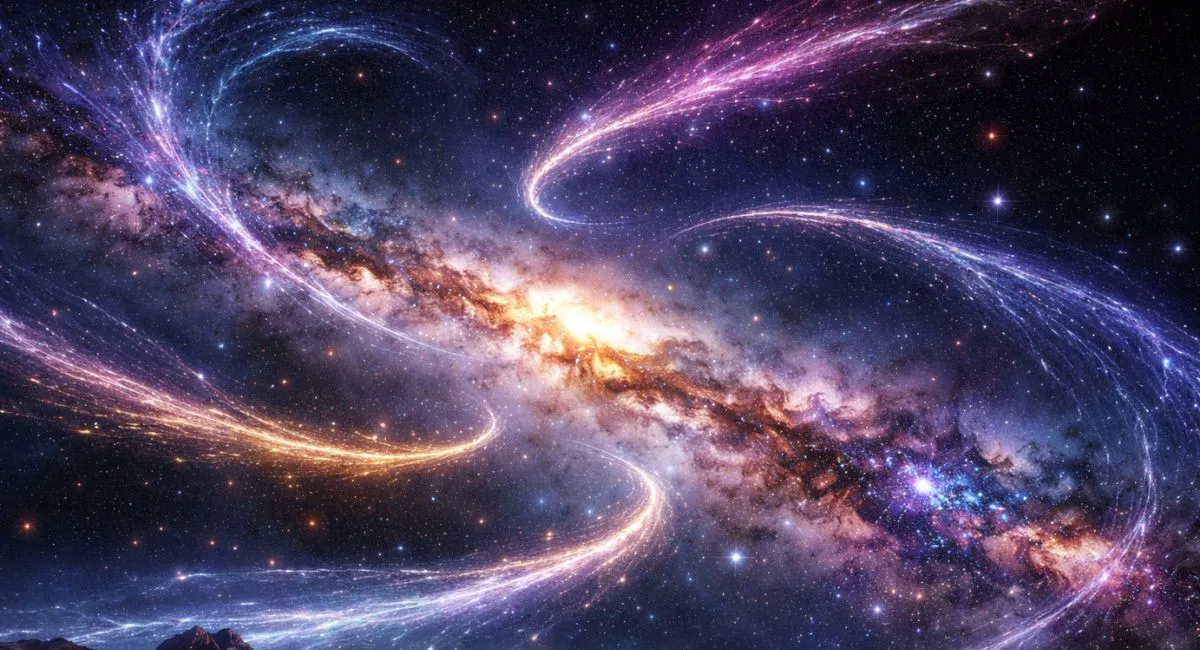
The recent breakthrough in Stellar Streams research has significantly expanded our understanding of the Milky Way.
Astronomers studying the galaxy’s outer halo have identified dozens of new stellar stream candidates, offering fresh insight into how our galaxy formed and evolved.
These faint trails of stars, created as clusters are gradually torn apart by gravity, are proving to be powerful tools for mapping unseen matter and reconstructing cosmic history.
What Are Stellar Streams?
Stellar Streams are elongated trails of stars formed when smaller systems—such as globular clusters or dwarf galaxies—are stretched and disrupted by the Milky Way’s gravitational forces. As these systems orbit the galaxy, they lose stars that continue along the same path, forming thin, coherent structures.
Unlike the dense and complex galactic disk, these streams act like clean tracers of gravitational influence. Their shapes, widths, and distortions reveal how mass—including invisible dark matter—is distributed throughout the galaxy.
A Massive Increase in Known Streams
For many years, astronomers had identified fewer than 20 confirmed stellar streams linked to surviving globular clusters.
However, a new study led by Yingtian Chen at the University of Michigan has identified 87 candidate streams, representing a substantial increase in the known number.
Although not all candidates are guaranteed to be genuine, this expanded catalog allows scientists to study patterns across a much larger sample instead of analyzing isolated cases. This shift enables more reliable conclusions about galactic structure and behavior.
Why Stellar Streams Matter?
The Milky Way contains hundreds of billions of stars, making it difficult to analyze its gravitational structure directly. Stellar Streams simplify this challenge by acting as natural “tracers” of gravitational forces.
Because these streams follow predictable orbital paths, astronomers can use them to:
- Map the distribution of visible and dark matter
- Study the galaxy’s formation history
- Detect irregularities caused by unseen mass
Their clarity and structure make them one of the most effective tools for probing the invisible components of the universe.
How do Stellar Streams Form?
The formation of Stellar Streams can be understood through a simple analogy. Imagine carrying a leaking bag of sand while riding a bicycle—the grains that fall behind trace your path. Similarly, globular clusters lose stars over time due to gravitational interactions.
These clusters, though dense and ancient, are gradually stretched and stripped. The stars that escape don’t disperse randomly; instead, they form a trail that records the cluster’s journey and the forces it encountered.
Challenges in Detecting Stellar Streams
Despite their importance, finding Stellar Streams is extremely challenging. They are faint, low-contrast features hidden among countless background stars. Some appear narrow and well-defined, while others are diffuse and harder to distinguish.
In the past, many discoveries were accidental—astronomers noticed unusual patterns in survey data. This method was slow and inefficient, limiting the number of known streams.
A New Systematic Approach
To overcome these challenges, researchers developed a new algorithm called StarStream. Instead of searching randomly, this method uses theoretical models to predict what a stellar stream should look like.
By focusing on expected patterns in star motion and distribution, the algorithm can identify potential streams more efficiently. This approach represents a major step forward, allowing astronomers to process vast datasets with greater accuracy.
The Role of Gaia Mission
A key factor behind this discovery is the European Space Agency’s Gaia mission, which operated between 2014 and 2025. Gaia mapped billions of stars, measuring not only their positions but also their motions with remarkable precision.
This motion data is essential for identifying Stellar Streams, as true streams consist of stars moving together through space. With Gaia’s detailed observations, astronomers can distinguish genuine streams from random alignments.
Implications for Future Research
The discovery of 87 candidates opens the door to deeper investigations into the Milky Way. With a larger dataset, scientists can now explore broader questions, such as:
- Do stream properties vary across different regions of the galaxy?
- Are certain orbital paths more likely to produce clear streams?
- What do these patterns reveal about dark matter distribution?
Even uncertain candidates contribute valuable information, helping refine detection methods and improve future studies.
The rapid expansion in known Stellar Streams marks a turning point in galactic research. From fewer than 20 to 87 candidates, astronomers now have a powerful dataset to explore the Milky Way’s structure and hidden mass.
With advanced tools like the StarStream algorithm and high-precision data from Gaia, these once-rare features are becoming essential instruments for understanding our galaxy.
As future observations refine these findings, stellar streams will continue to illuminate the unseen forces shaping the universe.
FAQs
What are stellar streams in simple terms?
Stellar streams are long trails of stars formed when the Milky Way’s gravity pulls apart star clusters or small galaxies.
Why are stellar streams important?
They help astronomers map dark matter and understand the structure and history of the Milky Way.
How were these new streams discovered?
Scientists used the StarStream algorithm along with Gaia mission data to identify patterns in star motion and distribution.