
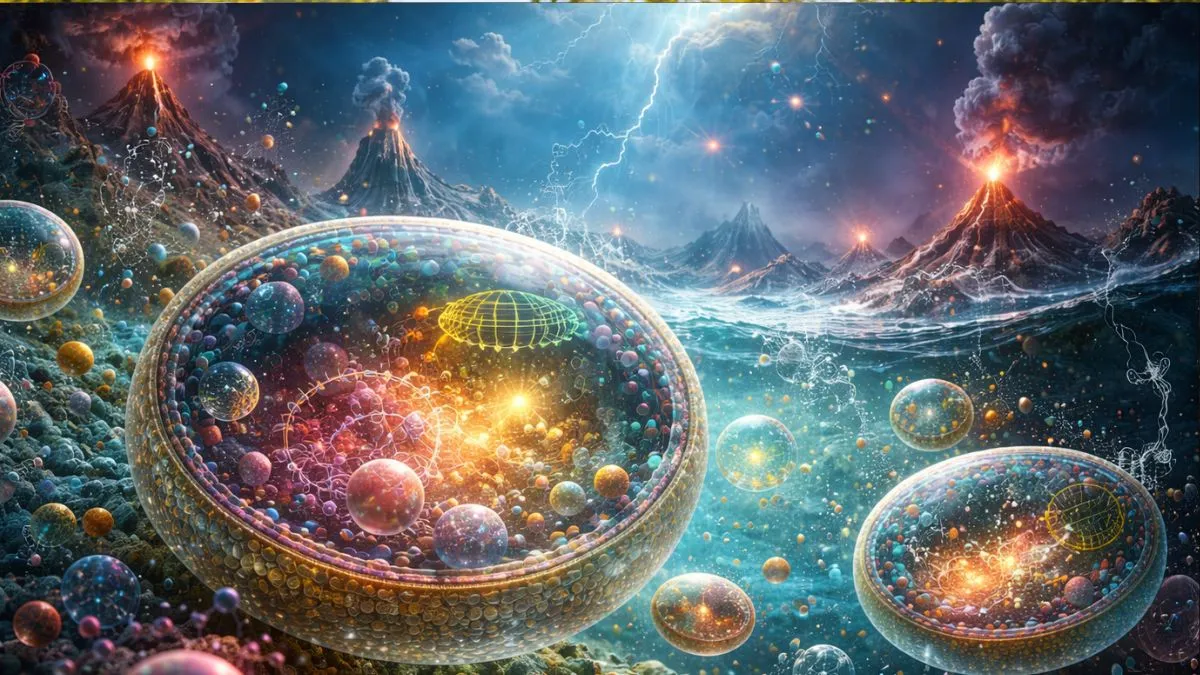
For decades, the chemoton theory remained in obscurity, largely ignored by mainstream science.
Today, however, the chemoton theory is gaining renewed attention as researchers revisit one of biology’s biggest mysteries—the origin of life.
Developed by Hungarian biochemist Tibor Gánti, this concept proposes a structured and integrated model of the simplest living system, offering fresh insights into how life may have first emerged on Earth.
Who Was Tibor Gánti?
Tibor Gánti, born in 1933 in Hungary, lived through a time of political and scientific isolation due to the Cold War. Much of his work unfolded behind the Iron Curtain, limiting its global reach. When he passed away in 2009 at the age of 75, his contributions were still relatively unknown.
Despite this, Gánti’s work is now being rediscovered. His chemoton theory is increasingly recognized as a pioneering attempt to define life in structural and functional terms rather than relying solely on molecules like DNA or RNA.
The Challenge of Defining Life
Understanding life’s beginnings has always been complex. Scientists still struggle to answer fundamental questions:
- What conditions existed on early Earth?
- Which chemical compounds were essential for life?
- What constituted the very first organism?
There is no universally accepted definition of life. A 2012 study even identified 123 different definitions. While some definitions focus on reproduction, they fall short since many organisms cannot reproduce independently.
Others, like NASA’s definition of life as a “self-sustaining chemical system capable of Darwinian evolution,” remain too broad.
This is where the chemoton theory offers a unique perspective.
What Is the Chemoton Theory?
The chemoton theory proposes a minimal model for life, built on three essential components that must work together:
1. Metabolism
A network of chemical reactions that enables the system to grow and sustain itself.
2. Genetic Information System
A mechanism to store and replicate information, similar to genes in modern organisms.
3. Membrane Boundary
A protective outer layer that encloses the system, preventing it from dispersing into the environment.
Gánti argued that these three elements must coexist and interact for life to exist. His chemoton theory emphasized that life is not defined by a single molecule but by the organization of interconnected systems.
Scientific Context and Competing Models
The early 1970s saw several important theories about life’s origins emerge:
- Autocatalytic systems by Stuart Kauffman, focusing on self-sustaining chemical networks.
- Hypercycle theory by Manfred Eigen, combining chemical cycles with genetic replication.
While these ideas addressed parts of the puzzle, the chemoton theory integrated all essential components into a single unified system. This made it more comprehensive, though also more complex.
Why Was the Chemoton Theory Ignored?
Despite its depth, the chemoton theory did not gain immediate recognition. Several factors contributed:
- Limited translation and accessibility of Gánti’s work
- Scientific isolation during the Cold War
- Preference for simpler models like the RNA world hypothesis
- Gánti’s challenging personality
As a result, simpler theories dominated the field, pushing the chemoton theory into the background for decades.
Modern Research and Renewed Interest
In recent years, scientists have started to revisit integrated models of life. Experiments in synthetic biology and origin-of-life research are beginning to align with Gánti’s ideas.
For example, researchers have developed protocells—simple cell-like structures capable of growth, division, and RNA replication. These systems demonstrate how metabolism, genetic material, and membranes can function together, echoing the principles of the chemoton theory.
Although a fully functional chemoton has not yet been created in a lab, ongoing research suggests that its components can arise from basic chemical processes. This strengthens the relevance of the chemoton theory in modern science.
A New Way to Understand Life
One of the most significant contributions of the chemoton theory is its broader definition of life. Instead of focusing on specific molecules, it highlights the importance of structure and organization.
This perspective is particularly valuable in fields like astrobiology, where scientists search for life beyond Earth. The chemoton theory provides a universal framework that could apply to life forms with entirely different الكيميकल compositions.
The chemoton theory stands as a powerful reminder that groundbreaking ideas can take decades to gain recognition. Tibor Gánti’s vision of life as a coordinated system of metabolism, information, and boundaries offers a deeper and more holistic understanding of biology.
As modern research continues to explore the origins of life, the chemoton theory is proving to be more than just a forgotten concept—it is a foundational framework that may ultimately help scientists unravel one of the greatest mysteries of existence.
FAQs
1. What is the chemoton theory?
The chemoton theory is a model proposed by Tibor Gánti that defines life as a system combining metabolism, genetic information, and a membrane boundary.
Why is the chemoton theory important today?
It provides a comprehensive framework for understanding life’s origins and is influencing modern research in synthetic biology and astrobiology.
3. Has a chemoton been created in a laboratory?
No, scientists have not yet fully recreated a chemoton, but experiments with protocells are moving closer to this goal