
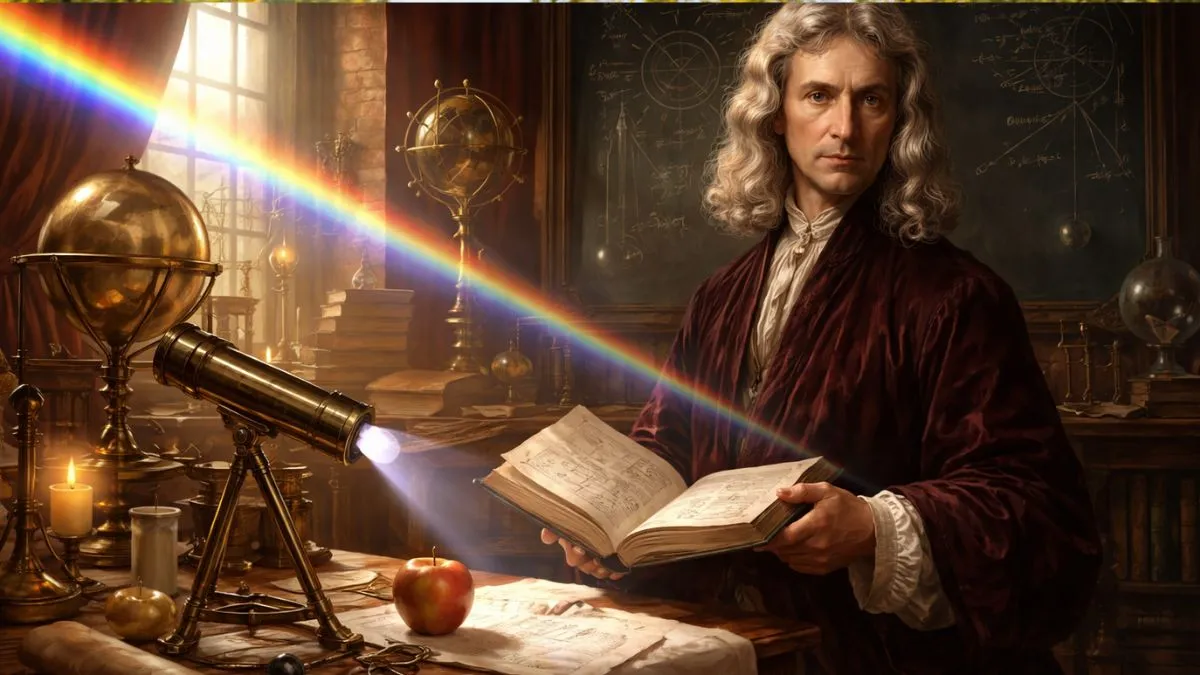
The Father of Physics is a title often given to a scientist who transformed the way we understand the universe.
The term Father of Physics commonly refers to Galileo Galilei, whose groundbreaking work laid the foundation for modern scientific thinking.
Physics itself is the study of matter, energy, motion, and the forces that govern the natural world. From falling objects to planetary motion, physics explains the rules that shape everything around us.
What is Physics?
Physics is a branch of science that explores how energy and matter interact. It helps explain natural phenomena such as gravity, light, and motion.
The development of physics as a systematic field of study owes much to early scientists who questioned traditional beliefs and introduced experimentation.
Who is Known as the Father of Physics?
The title Father of Physics is most commonly attributed to Galileo Galilei. He was an Italian scientist born in the late 16th century who revolutionised scientific thinking by introducing experimentation and observation as essential tools for discovery.
Before his time, people largely relied on ancient Greek philosophies without verifying them. Galileo challenged these ideas by conducting experiments and proving theories through evidence, which is why the Father of Physics title is widely associated with him.
Why is Galileo Called the Father of Physics?
Galileo Galilei earned the title Father of Physics because he transformed science from a belief-based system into an evidence-based discipline. One of his most famous contributions was demonstrating that objects fall at the same rate regardless of their weight, contradicting earlier beliefs.
He also improved the telescope and used it to make remarkable astronomical discoveries. Galileo observed the moons of Jupiter, providing strong evidence that not everything revolves around Earth. This finding supported the heliocentric model, which states that planets orbit the sun.
By emphasizing experimentation, Galileo introduced the scientific method, which remains a cornerstone of modern science. His approach reshaped how scientists study the natural world, reinforcing his reputation as the Father of Physics.
Contributions and Discoveries
The achievements of Galileo Galilei played a crucial role in shaping physics:
- Law of Falling Bodies: He proved that all objects fall at the same speed in the absence of air resistance.
- Astronomical Observations: He discovered Jupiter’s moons and supported the heliocentric theory.
- Scientific Method: He promoted experimentation and observation over blind acceptance of ideas.
These contributions established him firmly as the Father of Physics and influenced generations of scientists.
Other Scientists Associated with the Title
While Galileo is widely recognized as the Father of Physics, other scientists have also made significant contributions:
- Isaac Newton is known for his laws of motion and universal gravitation.
- Albert Einstein is often called the father of modern physics due to his theory of relativity.
Despite their contributions, the title Father of Physics is most often linked to Galileo because he laid the groundwork for experimental science.
Importance of Galileo’s Work Today
The influence of Galileo Galilei continues to shape modern science. His insistence on testing ideas through experiments forms the basis of scientific research today. Without his contributions, physics might not have developed into the precise and evidence-driven field it is now.
The legacy of the Father of Physics is visible in every scientific discovery, from space exploration to technological advancements. His work encourages curiosity, critical thinking, and innovation.
In conclusion, the title Father of Physics is most commonly given to Galileo Galilei for his revolutionary contributions to science. By introducing experimentation and challenging traditional beliefs, he transformed physics into a modern discipline.
While scientists like Isaac Newton and Albert Einstein also made remarkable contributions, Galileo’s role in establishing the scientific method makes him the true pioneer. His legacy continues to inspire scientific exploration and discovery even today.
FAQs
Who is called the Father of Physics?
The Father of Physics is commonly known as Galileo Galilei due to his pioneering use of experiments and observations.
Why is Galileo important in physics?
He introduced the scientific method, proved laws of motion, and made key astronomical discoveries that changed our understanding of the universe.
Are there other scientists called the Father of Physics?
Yes, Isaac Newton and Albert Einstein are sometimes given similar recognition, but Galileo is most widely accepted.