
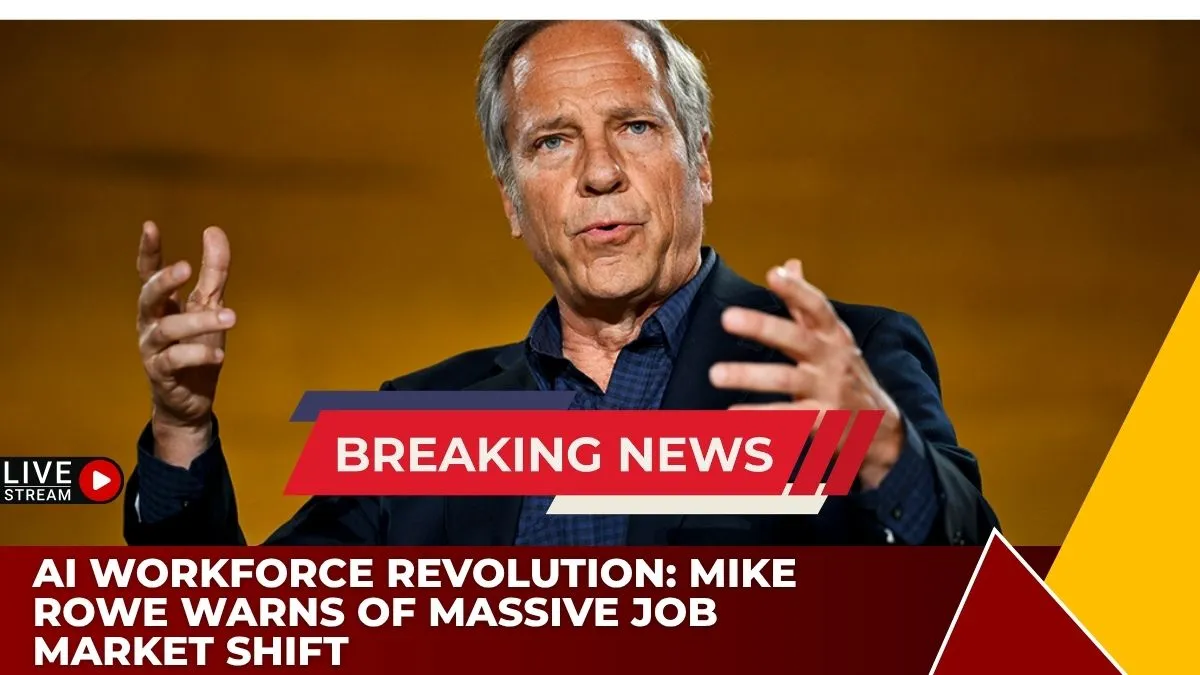
The AI Workforce Revolution is rapidly becoming a defining issue in today’s economy, with experts warning of unprecedented disruption.
Mike Rowe, CEO of the mikeroweWORKS Foundation, has raised serious concerns about a looming transformation in the labor market. Interestingly, his views align with those of Bernie Sanders, highlighting a rare bipartisan acknowledgment of the challenges ahead.
Rowe emphasizes that the AI Workforce Revolution is not just about automation replacing jobs—it is also about a growing shortage of skilled workers needed to support expanding infrastructure tied to artificial intelligence.
Rising Demand for Skilled Trades
One of the most striking aspects of the AI Workforce Revolution is the increasing demand for skilled trade professionals. As companies invest heavily in data centers, energy systems, and AI infrastructure, the need for electricians, welders, and technicians is surging.
Rowe pointed out that in some regions, electricians are earning salaries comparable to—or even exceeding—those in traditional white-collar professions. Employers are competing intensely for a limited talent pool, driving wages higher and reshaping career expectations.
This shift signals that the AI Workforce Revolution is redefining what constitutes a “high-value” career, placing blue-collar roles at the center of economic growth.
Infrastructure Boom and Workforce Challenges
The ongoing infrastructure expansion tied to AI is expected to involve trillions of dollars in investment. However, the success of this buildout depends heavily on workforce readiness.
According to Rowe, the AI Workforce Revolution will test whether the U.S. has enough trained professionals to meet demand. The shortage of skilled labor could become a bottleneck, slowing down progress and increasing costs.
He warns that without immediate action to train the next generation, industries may struggle to keep up with the pace of technological advancement.
A Rare Agreement Across Political Lines
The AI Workforce Revolution has created an unusual alignment between different political perspectives. Bernie Sanders has also raised concerns about the impact of AI on workers, emphasizing economic disruption and job displacement.
Rowe openly acknowledged this agreement, stating that the country is on the verge of a transformation “unlike anything we’ve ever seen.” This consensus underscores the urgency of addressing workforce challenges before they escalate further.
Changing Perceptions of Education and Careers
Another major implication of the AI Workforce Revolution is the shifting perception of education. For decades, college degrees were seen as the primary path to success. However, the current trend suggests otherwise.
Trade jobs—often overlooked in the past—are now becoming essential to supporting the digital economy. Roles such as:
- Electricians
- Pipefitters
- CNC operators
- Welders
are experiencing renewed importance and demand.
Rowe believes this shift could lead to a “renaissance” in skilled trades, as these professions become critical to sustaining technological growth.
AI’s Dual Impact on the Job Market
The AI Workforce Revolution is not solely about job loss; it also presents opportunities. While some roles may become obsolete, new ones are emerging that require specialized skills.
At the same time, concerns are growing about what some describe as the “invisible layoff,” where workers are gradually edged out of the job market due to automation and changing requirements.
This dual impact highlights the complexity of the AI Workforce Revolution, making workforce training and adaptability more important than ever.
The AI Workforce Revolution is reshaping the economic landscape in profound ways. As highlighted by Mike Rowe and echoed by Bernie Sanders, the combination of rapid technological advancement and a shortage of skilled labor is creating both challenges and opportunities.
The future will depend on how effectively the workforce adapts to these changes. Investing in training, rethinking education pathways, and recognizing the value of skilled trades will be crucial in navigating this transformation.
If addressed properly, the AI Workforce Revolution could lead to a stronger, more balanced economy—but failure to act may result in significant disruptions.