
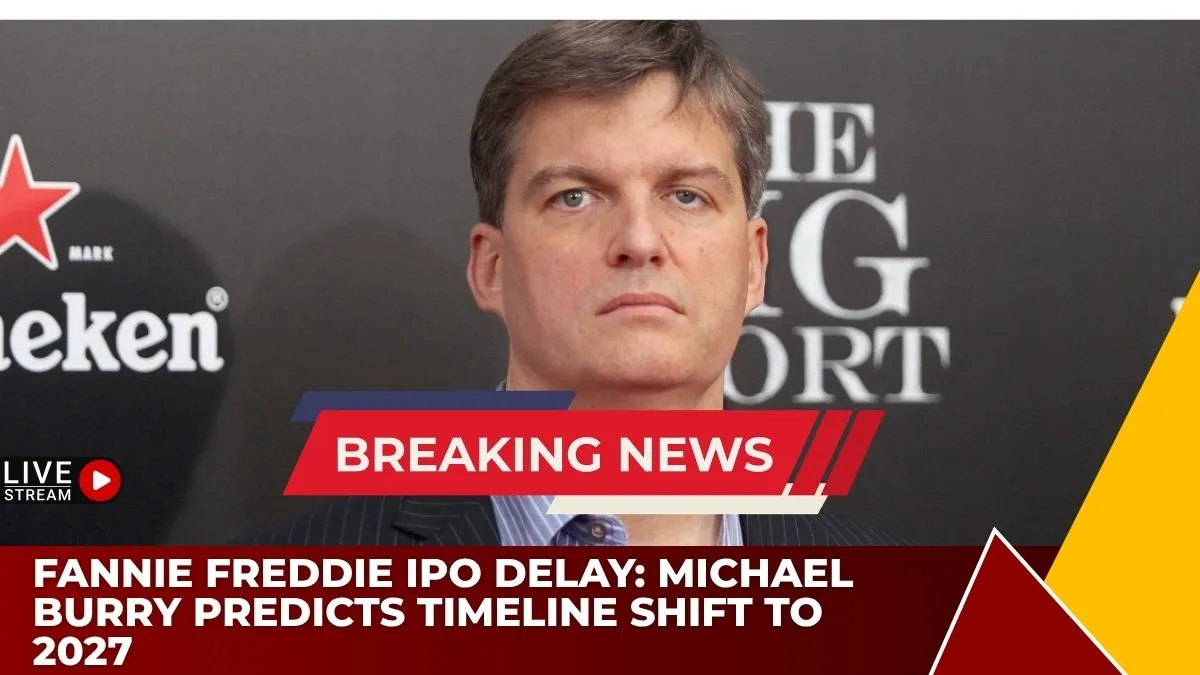
The Fannie Freddie IPO is facing a significant delay, according to renowned investor Michael Burry, best known for his role in The Big Short.
In a recent Substack post, Burry suggested that the much-anticipated Fannie Freddie IPO will not take place before 2027, citing economic instability and housing market concerns.
This forecast challenges earlier expectations tied to plans during the administration of Donald Trump, which aimed to bring Fannie Mae and Freddie Mac back into the public spotlight through a major listing.
Why the Fannie Freddie IPO Is Being Delayed?
Burry highlighted multiple economic pressures that could prevent the Fannie Freddie IPO from happening anytime soon. Among the key factors are:
1. Housing Market Instability
The current housing market remains fragile, with high property prices and increasing mortgage rates. According to Burry, these conditions are discouraging both buyers and sellers, leading to reduced inventory and distorted supply-demand dynamics.
He emphasized that elevated borrowing costs are directly impacting affordability, making it difficult for many potential homeowners to enter the market. This instability makes the Fannie Freddie IPO less viable in the short term.
2. Rising Interest Rates
Higher interest rates are adding pressure on mortgage markets, which are closely tied to the operations of Fannie Mae and Freddie Mac. As borrowing becomes more expensive, demand weakens, further complicating the environment required for a successful Fannie Freddie IPO.
3. Economic and Geopolitical Uncertainty
Burry also pointed to broader economic challenges, including inflationary tariffs and geopolitical tensions, such as a potential Iran conflict. These factors contribute to uncertainty in financial markets, reducing investor confidence and making large-scale offerings like the Fannie Freddie IPO risky.
Burry’s Warning: A Long Road Ahead
In his analysis, Burry described the path toward the Fannie Freddie IPO as a “steep, winding, and difficult climb.” He believes that while the IPO will eventually occur, it will only happen after significant economic adjustments and stabilization.
He warned that the housing market could face a prolonged downturn if current trends continue, describing the situation as a “long winter.” This outlook further supports his belief that the Fannie Freddie IPO timeline will extend beyond initial expectations.
Past Plans for the Fannie Freddie IPO
The idea of a Fannie Freddie IPO gained traction during Trump’s presidency. There were discussions about merging the two entities and listing them on the New York Stock Exchange under a unified ticker symbol.
Despite these ambitions, no concrete steps have been taken to execute the plan. As of now, both companies continue to trade on over-the-counter markets, reflecting the uncertainty surrounding their future.
Stock Performance and Market Reaction
Over the past six months, shares of both Fannie Mae and Freddie Mac have experienced a sharp decline, losing more than 70% of their value. This downturn signals weakening investor confidence and highlights the challenges facing the Fannie Freddie IPO.
The declining stock performance also reinforces Burry’s argument that current market conditions are not suitable for a large-scale public offering.
Impact on Investors and the Housing Sector
The delay in the Fannie Freddie IPO has implications for both investors and the broader housing industry. Investors anticipating a near-term IPO may need to adjust their expectations, while policymakers may need to reassess strategies for housing finance reform.
For the housing sector, continued uncertainty could slow growth and limit opportunities for expansion, especially in an already strained market environment.
The Fannie Freddie IPO is unlikely to materialize before 2027, based on insights from Michael Burry. With rising interest rates, housing market instability, and global economic uncertainties, the conditions required for a successful IPO are currently absent.
While the offering may eventually happen, it will likely follow a period of significant economic adjustment.
Until then, both investors and policymakers must navigate a challenging and uncertain landscape surrounding the future of Fannie Mae and Freddie Mac.