
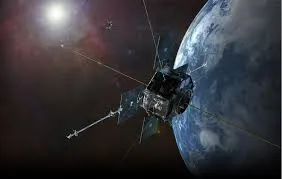
NASA Satellite: A large satellite developed by NASA is projected to fall back to Earth on Tuesday, March 10, after spending almost 14 years in space. Scientists say the spacecraft will reenter the planet’s atmosphere soon, though most of it will likely burn up before reaching the ground.
The satellite involved in this reentry event is the Van Allen Probe A, which weighs approximately 1,323 pounds (600 kilograms). It was launched in August 2012 together with its twin spacecraft, Van Allen Probe B.
Their mission was to investigate the powerful radiation belts that surround Earth, commonly known as the Van Allen radiation belts.
What Is the Van Allen Probe A?
The Van Allen Probe A is part of a scientific mission created to better understand the radiation zones encircling Earth. These belts are filled with high-energy charged particles trapped by Earth’s magnetic field and can pose risks to satellites, astronauts, and spacecraft electronics.
To study this environment in detail, NASA launched two nearly identical probes in 2012. Together, they collected important data about how radiation belts behave during solar storms and how they impact space technology.
Originally, the mission was known as the Radiation Belt Storm Probes before being renamed after American physicist James Van Allen, who first discovered these radiation zones in 1958.
Satellite Reentry Expected March 10
According to the United States Space Force, the satellite is predicted to reenter Earth’s atmosphere on Tuesday at approximately 7:45 p.m. EDT (2345 GMT). However, experts emphasize that the exact timing is uncertain and could vary by about 24 hours earlier or later.
Reentry predictions depend on many variables, including atmospheric conditions, solar activity, and the satellite’s current orbital decay rate. As new tracking information becomes available, specialists will refine their estimates.
Most of the Spacecraft Will Burn Up
NASA officials say that the majority of the spacecraft will likely disintegrate due to the intense heat generated during atmospheric entry. As the satellite travels at extremely high speeds, friction with atmospheric particles creates temperatures hot enough to destroy most of its structure.
Despite this, it is possible that some fragments could survive the reentry process and reach Earth’s surface.
However, the chance of those remnants causing damage is extremely small. NASA estimates the risk of a person being harmed at roughly 1 in 4,200, which translates to around 0.02%.
Why the Risk to People Is Extremely Low?
One major reason the risk remains minimal is the vast amount of ocean covering the Earth. Approximately 70% of the planet’s surface is water, meaning debris from reentering satellites is far more likely to land in open seas rather than populated regions.
Even if fragments survive the descent, they will most likely fall into remote ocean areas where they pose no threat to people or infrastructure.
Additionally, spacecraft engineers often design satellites with materials that break apart easily during atmospheric reentry, further reducing potential hazards.
Mission History of the Van Allen Probes
The Van Allen Probes mission played a major role in improving scientists’ understanding of Earth’s radiation environment.
After launch, the spacecraft travelled in a highly elliptical orbit around Earth. At their closest point, they came within 384 miles (618 kilometres) of the planet’s surface. At their farthest distance, they reached approximately 18,900 miles (30,415 kilometres) from Earth.
This unique orbit allowed the probes to repeatedly pass through different regions of the radiation belts, collecting valuable data during each orbit.
Both spacecraft were officially deactivated in 2019 after completing their scientific objectives. Since then, their orbits have gradually decayed due to atmospheric drag, eventually leading to the upcoming reentry of Van Allen Probe A.
Why Studying Radiation Belts Is Important?
Understanding the behaviour of the Van Allen radiation belts is critical for modern space operations. These belts can intensify during solar storms, potentially damaging satellites, communication systems, and navigation technology.
The data gathered by the Van Allen Probes has helped scientists improve space weather forecasting and develop better protection strategies for satellites and astronauts.
As humanity continues to expand its presence in space, knowledge from missions like this becomes increasingly important.
What Happens During Satellite Reentry?
When satellites reenter Earth’s atmosphere, they experience intense heating caused by friction with atmospheric gases. This heating can reach thousands of degrees, causing most components to melt, vaporise, or break apart.
Larger and denser pieces—such as fuel tanks or structural components—sometimes survive and reach the surface. However, these fragments usually fall into oceans or uninhabited areas.
Because of this, controlled or natural satellite reentries are generally considered low-risk events.
The upcoming return of the Van Allen Probe A marks the final stage of a mission that significantly improved our understanding of Earth’s radiation belts. After nearly 14 years in space, the satellite is expected to burn up in Earth’s atmosphere, with only a small chance that fragments will survive the descent.
Although the possibility of debris reaching the surface exists, the risk to people remains extremely low. Most of the spacecraft will disintegrate before reaching the ground, and any remaining pieces are likely to land in the ocean.
Overall, the mission’s scientific contributions continue to benefit researchers studying space weather and the challenging radiation environment surrounding our planet.