
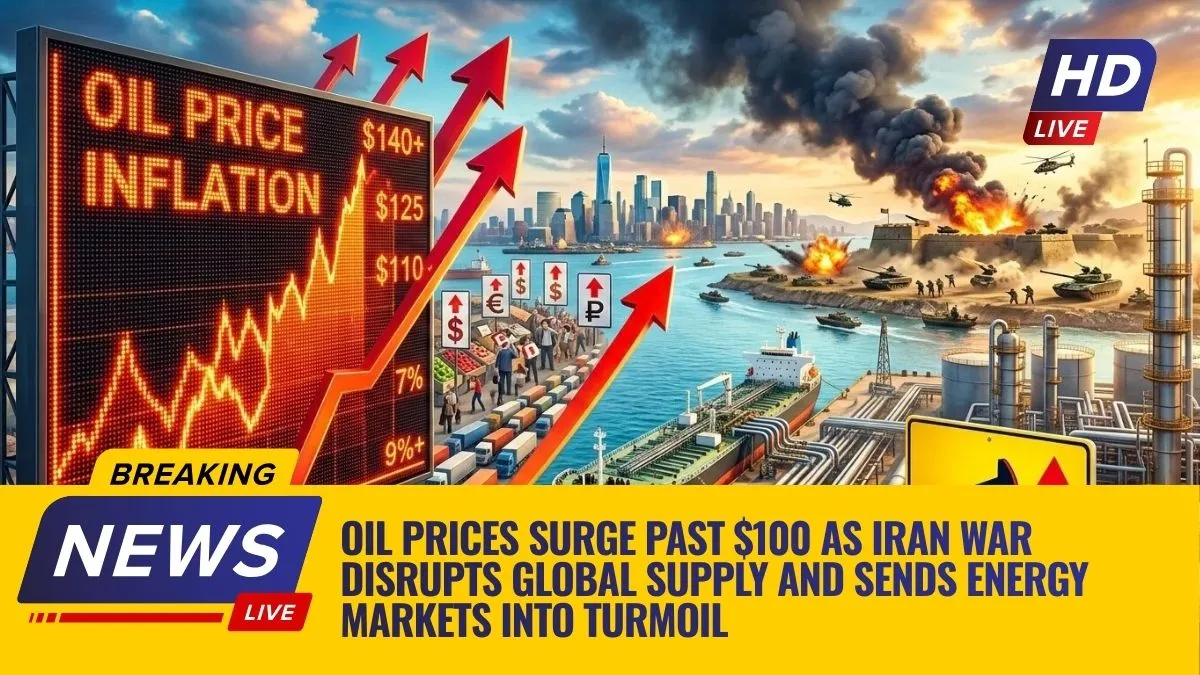
The global energy market has been shaken as Oil Prices Surge past the critical $100 per barrel mark for the first time since 2022. The dramatic spike comes as the Iran war intensifies, disrupting global oil supplies and creating new uncertainty across international energy markets.
Analysts warn that the ongoing conflict is already affecting global shipping routes, oil production, and export infrastructure. As Oil Prices Surge, consumers around the world — particularly drivers in the United States — are beginning to feel the financial impact through rising fuel prices.
The situation has also created political pressure in Washington, where leaders are scrambling to manage the consequences of the sudden increase in global energy costs.
Oil Prices Surge Above $100 for First Time Since 2022
Energy markets reacted quickly to the escalating conflict. On Sunday evening, the global benchmark Brent crude initially traded at $101.81 per barrel, while West Texas Intermediate (WTI) — the primary U.S. benchmark — reached $101.56 per barrel.
Prices did not stop there. Brent crude later climbed beyond $108, and overnight trading saw U.S. oil prices approach $120 per barrel, signaling strong market anxiety about supply disruptions.
The surge marks the first time since 2022 that oil has crossed the $100 threshold. At that time, prices rose sharply due to supply disruptions caused by Russia’s invasion of Ukraine and increased global demand following the COVID-19 pandemic.
Major Supply Shock Driving Oil Prices Surge
According to Rapidan Energy Group, the ongoing Iran conflict has already disrupted around 20% of global oil supply over the past nine days.
This level of disruption is historically significant. Analysts say it is more than double the previous record set during the 1956-57 Suez Crisis, which interrupted just under 10% of global supply.
The scale of disruption has pushed energy markets into a state of heightened volatility, fueling concerns that Oil Prices Surge could continue if the conflict escalates further.
Strait of Hormuz Tensions Threaten Global Energy Shipments
One of the biggest drivers behind the Oil Prices Surge is the rising risk around the Strait of Hormuz, a narrow but crucial shipping route located near Iran.
A significant portion of the world’s oil shipments travels through this strait each day. However, heightened military tensions and security risks are keeping many oil tankers away from the region.
Energy analysts say fears surrounding:
- Regional oil production
- Processing facilities
- Storage infrastructure
- Export terminals
are all contributing to the ongoing Oil Prices Surge.
If shipping through the Strait of Hormuz continues to face disruptions, global energy markets could experience further price spikes.
Impact on Gasoline Prices for Consumers
The Oil Prices Surge is already hitting drivers at the pump.
According to data tracked by AAA, the average price for regular gasoline in the United States has increased from approximately $3 per gallon before the military strikes to around $3.45 per gallon as of Sunday.
Energy analysts believe that additional increases may occur in the coming weeks if crude prices remain elevated.
Recent Gasoline Price Changes
| Period | Average U.S. Gasoline Price |
|---|---|
| Before Iran strikes | $3.00 per gallon |
| After conflict escalation | $3.45 per gallon |
| Mid-2022 peak | Over $5.00 per gallon |
Although prices are rising rapidly, they still remain below the historic highs seen in mid-2022, when U.S. gasoline briefly exceeded $5 per gallon.
Political Pressure Mounts as Oil Prices Surge
The sudden Oil Prices Surge has also created political challenges for President Donald Trump, who previously highlighted lower fuel costs as a major economic achievement.
In a statement posted on Truth Social, Trump acknowledged the short-term price increases but defended the broader strategy.
He wrote:
“Short term oil prices… will drop rapidly when the destruction of the Iran nuclear threat is over. This is a small price to pay for safety and peace.”
Administration officials are now working to prevent further energy market disruption.
Government Response to Rising Energy Costs
Several measures are being considered to manage the consequences of the Oil Prices Surge.
Actions under discussion include:
- Offering political risk insurance to shipping companies through the U.S. International Development Finance Corporation
- Considering naval escorts for oil tankers passing through the Strait of Hormuz
- Issuing a 30-day sanctions waiver allowing Indian refiners to purchase additional Russian oil
- Potentially releasing oil from the Strategic Petroleum Reserve
Energy Secretary Chris Wright said on Fox News that higher prices are temporary and could ease within weeks rather than months.
However, not all policymakers agree on the strategy. Senate Minority Leader Chuck Schumer has urged the administration to release oil from the national reserve to stabilize prices.
Production Disruptions Could Push Oil Prices Higher
Energy analysts warn that the situation could worsen if the conflict spreads across the region.
Already, production shutdowns have been reported in Iraq and Kuwait, according to Barclays analyst Amarpreet Singh. There are concerns that the disruptions could extend to:
- United Arab Emirates
- Saudi Arabia
If additional production cuts occur, the Oil Prices Surge could accelerate even further.
Forecast: Oil Prices Could Reach $120
Market analysts believe the current crisis could push oil prices significantly higher.
Barclays estimates that Brent crude could test $120 per barrel if the disruptions continue for several more weeks.
Such a move would represent a dramatic shift from earlier expectations that the global oil market would remain relatively stable throughout the year.
Analysts say the current risk environment may actually be more severe than the supply shock caused by the Russia-Ukraine war.
The latest Oil Prices Surge above $100 per barrel highlights the fragile balance of global energy markets. The escalating conflict involving Iran has disrupted a significant portion of global supply, raising fears of further price spikes if tensions continue.
With shipping risks increasing in the Strait of Hormuz and production disruptions already emerging in parts of the Middle East, energy markets remain highly volatile. Governments and policymakers are now racing to prevent the crisis from worsening while attempting to shield consumers from rising fuel costs.
If the conflict persists for several weeks, analysts warn that oil prices could climb even higher, potentially approaching $120 per barrel, creating new economic and political challenges worldwide.